A vertical vegetable garden grows food up a wall, railing or frame instead of across the floor, which makes it one of the most practical ways to get a real harvest from a balcony or small patio. The structure you pick decides what you can grow: a trellis suits climbers such as beans and cucumbers, while pockets, shelves and towers suit lettuce, herbs and strawberries.
This guide compares the main systems, matches crops to each one, and covers the parts that are easy to get wrong: shade between tiers, watering from top to bottom, and keeping the whole thing upright in wind.
Quick answer: Use a trellis or A-frame for climbing crops such as pole beans, peas and cucumbers, and pockets, shelves, towers or gutters for shallow-rooted crops such as lettuce, herbs and strawberries. Put fruiting crops where they get 6–8 hours of direct sun, leafy greens lower down where 3–5 hours will do, anchor every structure before you plant, and plan on daily watering or a drip line in summer.
The main vertical growing systems
Most vertical setups fall into two groups: supports that let plants climb, and stacked containers that fit many small plants into a small footprint. Many balconies end up using one of each, alongside the low-level options in small balcony garden ideas.
Trellises and netting
A trellis is the simplest option. Set it into a large container or fix it to a wall, then let climbing crops grow up it. Virginia Tech Extension's vertical gardening guide lists plastic netting, wood lattice, nylon fencing and woven wire as climbing surfaces, with holes no bigger than 4 inches (10 cm) across. If the trellis goes against a wall, WSU Clark County Extension says to leave a gap behind it for air circulation.
A-frames
An A-frame is two trellis panels leaning together and joined at the top. It stands on its own, so nothing has to be fixed to the building, and you can grow climbers up both faces. The shaded strip underneath can hold a row of lettuce, which Virginia Tech notes may benefit from the shade of taller crops.
Wall pockets and wall-mounted pots
Fabric or plastic pocket planters hang on a wall, fence or railing, and the RHS small-space guide suggests them for salad leaves, herbs and fruit. A sturdier version is a mesh panel with pots wired to it. For one RHS vegetable wall, the gardener fixed 2 × 2 in (5 × 5 cm) timber battens to a wall 8 ft (2.4 m) high, stapled galvanized mesh over them, and hung old catering tins and troughs on wire hooks. WSU also mentions containers made with one flat side for mounting on a wall or fence.
Tiered shelves, ladders and plant stands
Open shelving, a stepped plant stand or an old wooden ladder holds a lot of pots in very little floor space. The RHS suggests these for balconies and notes that metal versions hold up well in all weather. Because every pot is separate, you can swap a finished crop for a new one without disturbing the rest.
Stacking towers
Towers stack planting pockets around a central column. Utah State University Extension describes one stacking tower that can hold 50–60 plants. They suit small, shallow-rooted crops, and strawberries are a common choice; see best containers to grow strawberries for how towers compare with pots and bags.
Gutters, troughs and hanging baskets
Lengths of rain gutter or narrow troughs fixed in rows along a wall make shallow beds for salad greens. Shallow is fine for lettuce: University of Maryland Extension grows it on a salad table just 3½ inches (9 cm) deep and lists ½ gallon (about 2 L) as the minimum container for leaf lettuce. Hanging baskets add one more layer under an overhang. WSU suggests hanging them where they get morning sun and where you won't forget to water them.
Which crops suit each vertical system
Match the crop's root size and habit to the structure. Climbers need a frame and a big pot at the base; shallow-rooted crops are happy in pockets and gutters.
| System | Best crops | Size notes | Watch out for |
|---|---|---|---|
| Trellis or netting | Pole beans, peas, cucumbers, indeterminate tomatoes | Mesh no wider than 4 in (10 cm) | Anchor it before planting |
| A-frame | Cucumbers, peas, pole beans, small squash | Freestanding; lettuce fits underneath | Leaves on both faces catch wind |
| Wall pockets or wall pots | Salad leaves, herbs, strawberries, compact chilies | Leave 2 in (5 cm) headspace in pots | Small pockets dry out fast |
| Tiered shelves or ladder | Herbs, greens, compact fruiting crops in pots | Separate pots, easy to swap | Upper shelves shade lower ones |
| Stacking tower | Lettuce, herbs, strawberries | One tower may hold 50–60 plants | Upper pockets dry first |
| Gutters or troughs | Lettuce and salad greens | Lettuce grows in 3½ in (9 cm) | Too shallow for fruiting crops |
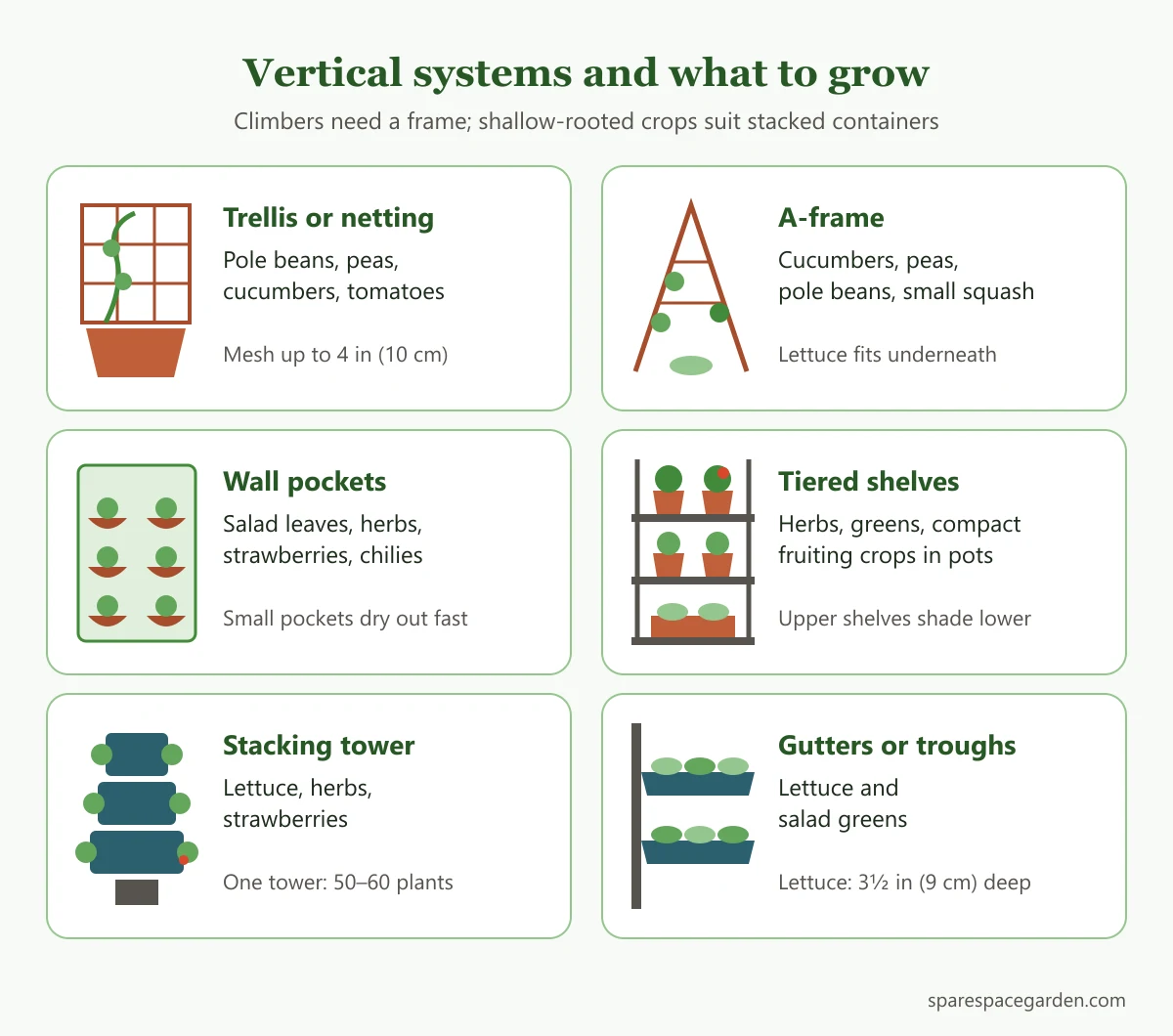 Six vertical systems and the crops each one handles best.
For climbers, WSU advises buying the vining varieties of beans, peas, cucumbers and squash rather than bush types, and says small-fruited squash and melons usually work best. The plant-by-plant details (pot sizes, support heights and how each crop holds on) are in climbing vegetable plants for small gardens. For the two most popular climbers, see growing cucumbers vertically and how to trellis squash.
How to build a simple vertical vegetable garden
Whichever system you choose, the order of work is the same.
- Count the sun first. Note how many hours of direct sun reach the wall or railing. University of Maryland Extension says warm-season crops need 6–8 hours and cool-season crops 3–5 hours.
- Ask before you drill. Brooklyn Botanic Garden advises getting permission from your landlord, co-op board or building superintendent before planting. Freestanding A-frames, shelf units and towers avoid fixings altogether.
- Pick the system and crops together. Use the table above, and keep deep-rooted fruiting crops in their own large pots at the base.
- Install and anchor the structure before planting. WSU says this prevents damage to the plants that would happen if you added it later.
- Fill with a lightweight mix. The RHS wall used lightweight multi-purpose compost. Leave about 2 inches (5 cm) of space above the mix in straight-sided pots and 3 inches (7.5 cm) in tapered ones so water doesn't spill over.
- Plant by light. On the RHS wall, taller crops such as chilies and tomatoes went higher up, cut-and-come-again leaves went where they were easy to reach, and cucumbers and eggplants sat in the warm pocket at the base.
- Set up watering before the plants fill in. Running drip tubing is much easier on a bare frame.
- Tie and support as they grow. WSU notes cucumber, squash and melon vines can reach 25 feet (7.6 m) and that heavy fruit may need slings made from old pantyhose or rags.
Light and shading between tiers
Every vertical structure casts a shadow. WSU puts it plainly: tall plants and structures shade their neighbors, so place shade-tolerant crops near them and check that nearby plants still get enough sun.
On a floor or wide balcony, put the tallest structure on the side away from the sun. Virginia Tech suggests planting bush beans, eggplant and peppers on the south side of taller crops so they get full sun, and UMD's Maryland Grows blog recommends placing trellises on the north side and not building them excessively tall. In the Southern Hemisphere, reverse this and keep tall frames on the south side.
On stacked shelves, each shelf shades the one below it. Put sun-hungry fruiting crops on the top shelf, herbs in the middle, and lettuce and other greens at the bottom, where 3–5 hours of sun is enough. If a tower or shelf gets light from only one side, turning it every few days helps even out growth.
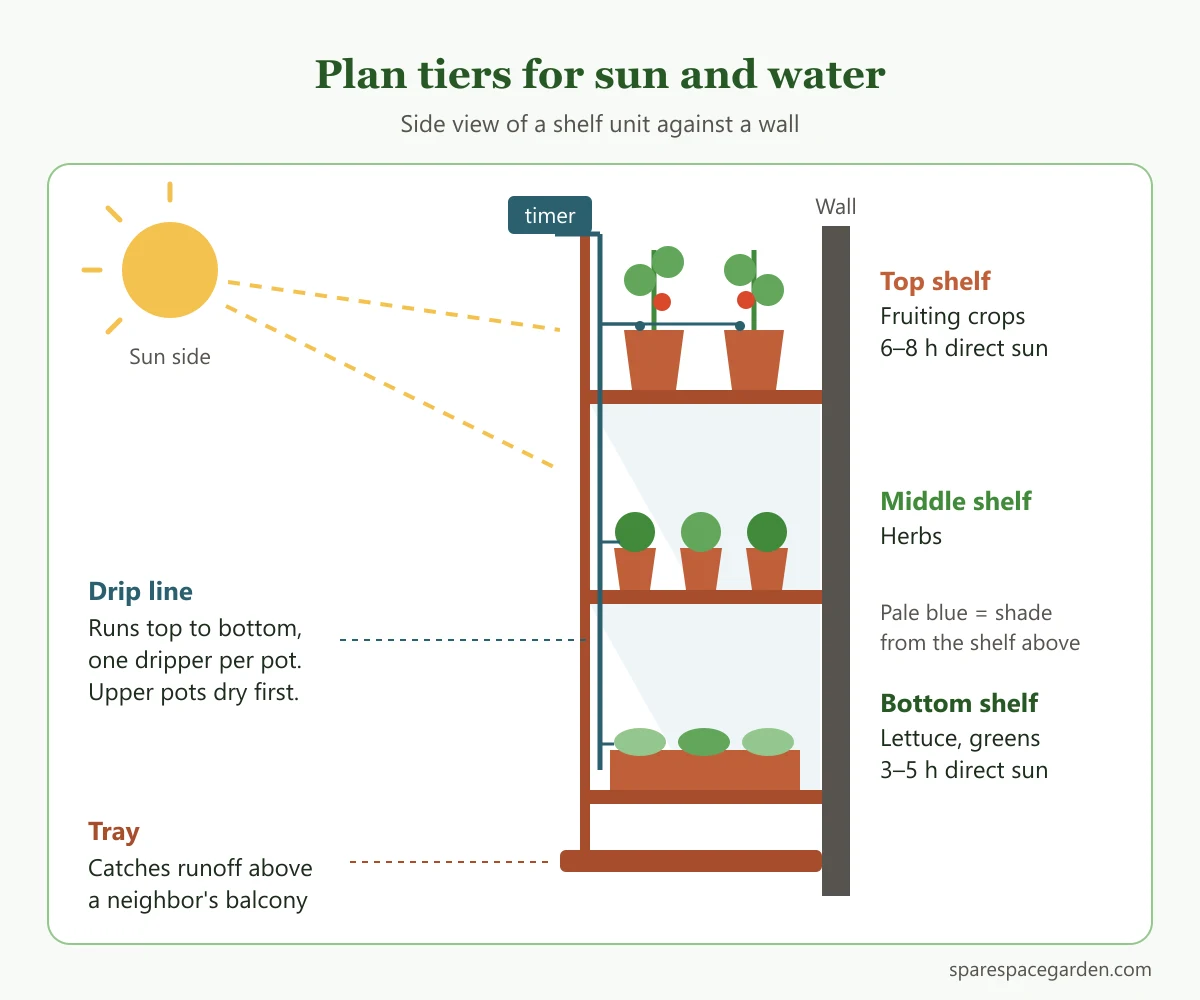 Put fruiting crops where the sun reaches, greens in the shade below, and run water from the top down.
Walls add heat as well as shade. The RHS says a south-facing wall gets the full heat of the summer sun for most of the day, with southwest and west walls also suitable for warm crops. WSU suggests asking whether a wall will reflect or radiate too much heat for the plants you have in mind.
Watering a vertical vegetable garden from top to bottom
Vertical gardens dry out faster than pots on the floor. WSU explains that plants grown vertically are exposed to more sun and wind, and that containers need watering daily and sometimes more often in hot weather. Small pockets and gutters hold very little mix, so they have the least margin.
Water drains downward through stacked systems. In a tower or pocket wall, water poured into the top runs through to the lower levels, so the bottom tends to stay wetter while the top dries first. Water the top tier, wait a minute, then check the lowest pockets before adding more.
Drip lines and timers
A drip system solves most of these problems. The RHS guide to watering methods explains that drip lines are calibrated to deliver a set amount, for example 2 liters (about half a gallon) per hour per dripper, and that they can be automated on a timer. It also advises adjusting timing and coverage so only the root zone gets wet, since extra water carries nutrients away. Brooklyn Botanic Garden notes that drip irrigation fed from a roof-level faucet is a common rooftop setup.
For a vertical garden, run the supply tube up one side of the structure, then branch off with a dripper for each pot, pocket or gutter section. Put a tray or trough at the very bottom to catch runoff, especially if a neighbor's balcony is below. The balcony raised garden bed guide covers trays and floor protection in more detail.
Tip: Run a new drip setup once while you watch. Every pot should drain a little from the bottom, and none should overflow. Adjust before you leave it on a timer.
Frequent watering washes nutrients out faster, and WSU notes vertical plants may need more frequent feeding. The RHS wall started a liquid tomato feed in mid-June. Follow the label on any fertilizer for rates.
Weight, anchoring and wind
A loaded vertical garden is heavier than it looks. UMD says a 20-inch (51 cm) container filled with moist mix and plants can weigh 100 pounds (45 kg). A wall of pots puts that kind of weight on a few fixings, and a tower concentrates it on a small base. No article can confirm what your wall, railing or balcony will carry, so check with your building manager first and ask a structural engineer or other qualified professional if you're unsure.
- Use strong fixings. The RHS roof garden advice says trellis and screen fixings must be well supported. On the RHS vegetable wall, each container hung from hooks sized for its weight.
- Add extra ties up high. The same wall used extra wire through the base of pots near the top, because higher pots catch more wind.
- Keep the profile low where it's windy. Brooklyn Botanic Garden suggests a secured trellis for shelter, low containers against perimeter walls, and square planters rather than top-heavy, vase-shaped ones.
- Filter the wind. The RHS notes solid screens create turbulence on their sheltered side, while slatted or mesh screens slow the wind more gently.
- Watch light mixes. The RHS advises fixing containers of peat-free mix in place so strong winds can't knock them over.
Watch out: Keep every pot and pocket on the inside of the railing. A planter that falls from a balcony can land on a person or a neighbor's space below.
Frequently asked questions
What vegetables grow best in a vertical garden?
Climbers such as pole beans, peas, cucumbers and indeterminate tomatoes do well on trellises and A-frames. Lettuce, salad leaves, herbs and strawberries suit pockets, towers, shelves and gutters. Large, heavy crops such as full-size squash are harder, so WSU recommends small-fruited varieties.
How do you water a vertical vegetable garden?
Check it daily in summer, water the top tier first, and let the runoff reach the lower levels before adding more. A drip line on a timer is the most reliable method, with one dripper per pot or pocket and a tray at the bottom to catch the excess.
Can you grow tomatoes in a vertical garden?
Yes. Indeterminate tomatoes can be tied up a tall stake or trellis, and the RHS suggests wire cages for tomatoes and peppers in small spaces. Trailing types grew well in pots on the RHS vegetable wall. Each plant still needs a decent pot at the base, so tomatoes don't belong in small pockets.
Does a vertical vegetable garden need full sun?
Fruiting crops do. UMD lists 6–8 hours of direct sun for warm-season crops and 3–5 hours for cool-season crops such as lettuce. A partly shaded wall can still grow greens and herbs, especially on the lower tiers.
How do I stop a vertical garden from blowing over?
Anchor the structure before you plant, tie freestanding frames to something solid, and keep the heaviest pots low. On exposed balconies, use slatted screens to slow the wind and avoid tall, top-heavy containers.