The most reliable home remedy for whiteflies on plants is a combination, not a single spray. Hose or vacuum the adults off, pick off leaves crowded with nymphs, hang yellow sticky traps to see how many are left, and use insecticidal soap or horticultural oil on leaf undersides if numbers stay high. Indoors and in greenhouses, a tiny parasitic wasp called Encarsia can finish the job.
Whiteflies are hard to wipe out once they're established. UC IPM says even the most toxic insecticides are only partially effective against them, so gentle methods repeated often tend to beat one harsh treatment.
Quick answer: Hose adults off with a strong stream of water or vacuum them from small plants, and prune out leaves covered in nymphs. Spray insecticidal soap or horticultural oil on leaf undersides when it's below 90°F (32°C), following the label and repeating every 7 to 10 days. Use yellow sticky traps mainly to monitor, skip homemade dish soap mixes, and check new plants before you bring them home.
How to tell you have whiteflies
Whiteflies are easy to recognize once you disturb a plant. The RHS guide to glasshouse whitefly describes adults as small, white-winged insects about 1.5 mm (1/16 inch) long that fly up when the plant is touched. The young stages (nymphs) are flat, oval, creamy-white scales on the undersides of leaves, about 1 mm long when fully grown.
Other signs include:
- Sticky leaves. Whiteflies excrete honeydew, which coats leaves, stems and fruit. Black sooty mold often grows on it.
- Yellowing. UC IPM's whitefly pest note says heavy feeding can turn leaves yellow, dry them out or make them drop.
- Ants. Ants feed on the honeydew and protect whiteflies from their natural enemies.
UC IPM points out that nymphs, not adults, cause most of the damage. Adults alone rarely do serious harm unless they carry a plant virus.
Why whiteflies matter more on tomatoes and peppers
Some whiteflies spread viruses. The sweetpotato whitefly (Bemisia tabaci), also called silverleaf whitefly, feeds on tomatoes, peppers and cucurbits, according to UC IPM. It spreads tomato yellow leaf curl virus, which has no cure once a plant is infected. Our guide to the cause of tomato leaf curl explains the symptoms and where the virus is most common.
How fast whiteflies multiply
Whiteflies breed quickly in warm weather. The RHS says each female can lay more than 200 eggs, and development takes about three weeks at 70°F (21°C) but several months at 50°F (10°C). Colorado State University Extension gives a generation time of three to four weeks under favorable conditions, with eggs laid on the undersides of the newest leaves and hatching in five to seven days.
That's why whiteflies are mainly a problem in greenhouses, sunrooms, warm windowsills and hot-summer regions. The RHS says glasshouse whitefly usually doesn't survive winter outdoors in the UK, though outdoor plants can host it in warm summers. In warmer parts of California, UC IPM says the common species breed year-round.
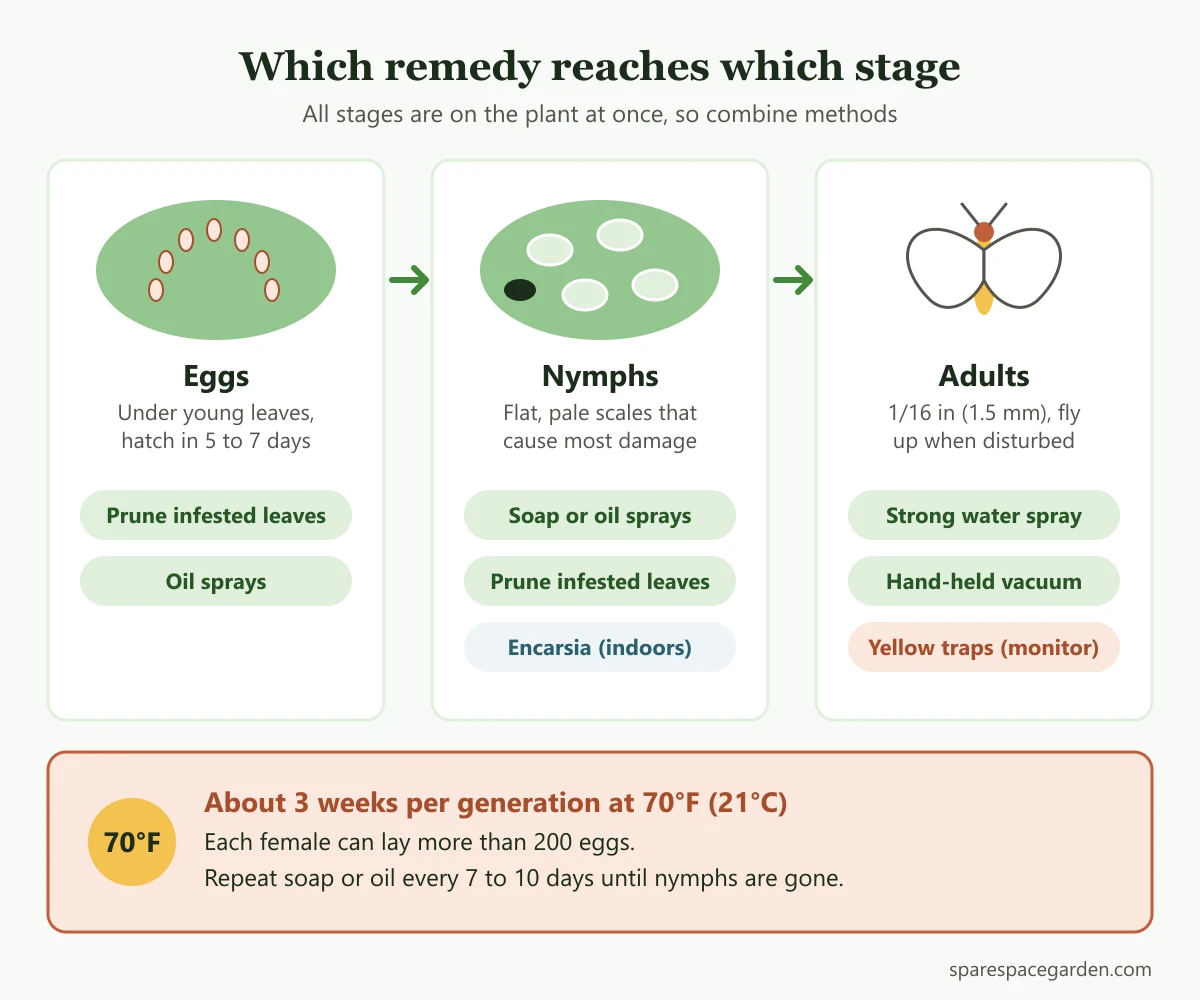 Each remedy reaches a different stage, which is why combining them works better.
The practical point: every life stage is present at once on an infested plant. Hosing and vacuuming remove adults, but eggs and nymphs stay put under the leaves. Plan on repeating treatments for several weeks.
Physical remedies: water, vacuum and pruning
If you want a home remedy for whiteflies on plants that costs almost nothing, start here. These methods don't harm the natural enemies that help control whiteflies.
Hose the adults off
UC IPM recommends hosing adults off plants with a strong stream of water. Aim at the undersides of leaves. On a balcony, a hose nozzle or a pump sprayer works; for houseplants, a lukewarm shower does the same job. Repeat every few days while you still see adults flying up.
Vacuum small plants
A hand-held vacuum works well on small plants. Colorado State's guide to managing houseplant pests says adult whiteflies on small plants can be eliminated by vacuuming, and that regular use of small hand-held vacuums helps control them. Hold the nozzle close to the leaves without sucking them in, then seal the contents in a bag before they can escape.
Remove infested leaves
UC IPM suggests pruning out isolated infested leaves as soon as you spot them, and hand-removing heavily infested leaves or plants. That can bring numbers down to a level natural enemies can handle. Look for leaves whose undersides are dotted with flat, pale scales, and bag them for the trash.
Tip: At the end of the season, pull out tomato, pepper and other vegetable plants after the last harvest. UC IPM recommends removing vegetable plants after harvest so whiteflies don't carry over onto the next crop.
Yellow sticky traps: monitoring, not a cure
Adult whiteflies are drawn to yellow, and sticky cards catch them. But UC IPM describes traps as most useful for monitoring and detecting whiteflies rather than controlling them, and Colorado State says trapping alone won't eliminate the problem. Traps only catch adults, and the nymphs keep feeding.
To get the most from them, follow UC IPM's tips:
- Use about one trap for every medium-size vegetable plant.
- Hang traps level with the infestation, sticky side facing the plants and out of direct sunlight.
- Clean or replace them periodically so you can see new catches.
UC IPM also describes a homemade version: a board painted bright yellow and coated with one part petroleum jelly or mineral oil mixed with one part household detergent.
Watch out: The RHS warns that sticky traps also catch beneficial insects, including the parasitic wasps used against whiteflies. If you release Encarsia, use fewer traps or remove them.
Insecticidal soap and horticultural oil
When physical methods can't keep up, soap and oil are the lowest-impact sprays. They mainly work on nymphs. Colorado State's houseplant guide rates horticultural oil as controlling nymphs but not adults, and insecticidal soap as suppressing nymphs but not adults.
Both kill only what they touch, and UC IPM says they may reduce but not eliminate whitefly populations. Coverage of leaf undersides is everything, since that's where nymphs and eggs sit.
| Remedy | Stage it hits | How often | Main caution |
|---|---|---|---|
| Strong water spray | Adults | Every few days | Spray early so leaves dry |
| Hand-held vacuum | Adults | Every few days | Seal contents in a bag |
| Pruning infested leaves | Eggs and nymphs | As soon as seen | Don't strip the plant bare |
| Yellow sticky traps | Adults (monitoring) | Check weekly | Also catch beneficial insects |
| Insecticidal soap | Nymphs | Every 7 to 10 days | Above 90°F (32°C), stressed plants |
| Horticultural or neem oil | Nymphs and eggs | Every 7 to 10 days | Heat, slow drying, sensitive plants |
| Encarsia wasps | Nymphs | One or more releases | Indoors and greenhouses only |
Follow these rules from UC IPM, Colorado State and UConn Extension:
- Follow the label. Use only products labeled for your plant, at the rate shown.
- Spray under 90°F (32°C). UC IPM says to spray only when plants aren't drought-stressed and temperatures are below 90°F, and suggests early evening, when there's light but no direct sun on the plants.
- Repeat. Colorado State recommends repeating every 7 to 10 days until eggs and nymphs are gone.
- Test first. UConn Extension's insecticidal soap fact sheet suggests treating part of a plant and waiting at least 24 hours before spraying the rest. Its list of plants that may be sensitive includes cucumber, begonia, fuchsia and impatiens.
For detail on how soaps and oils affect bees and beneficial insects, see our guide on how to get rid of aphids naturally, which covers the same products.
Home remedies to skip
Not every popular home remedy for whiteflies on plants holds up.
Dish soap mixes. It's the most shared recipe online, and extension services advise against it. Colorado State's insecticidal soap fact sheet says dish soaps contain detergents that can injure plants, and that homemade soap solutions are not recommended for insect control. UConn adds that dish soaps and detergents can strip the waxy protective layer from leaves. A registered insecticidal soap is a different product, made from potassium salts of fatty acids, with a tested label rate.
Kitchen sprays. Garlic, vinegar and similar mixes appear on many gardening sites, but none of the extension guides used for this article (UC IPM, the RHS, Colorado State, UConn and University of Maryland) lists them as whitefly controls. Without a label, there's no tested rate, and a strong mix can burn leaves.
Broad-spectrum insecticides. Reaching for a strong spray often makes things worse. UC IPM names carbaryl, pyrethroids, organophosphates and neonicotinoids such as imidacloprid as disruptive, because they kill natural enemies while whiteflies quickly build resistance. It adds that imidacloprid can trigger spider mite outbreaks, a problem covered in our guide to cucumber spider mites.
Natural enemies and reflective mulch
Encarsia for indoor plants and greenhouses
Encarsia formosa is a tiny parasitic wasp that lays its eggs inside whitefly nymphs. The RHS says parasitized nymphs turn black, which makes progress easy to track, and advises introducing the wasps before plants are heavily infested, since they can't give instant control.
Temperature matters. Colorado State's greenhouse whitefly page says Encarsia works best between 68°F and 77°F (20°C and 25°C), and its houseplant guide says parasitic wasps need temperatures averaging at least 72 to 75°F (22 to 24°C). UC IPM says Encarsia is available for greenhouse release but isn't generally recommended outdoors in temperate areas, because it doesn't survive well there.
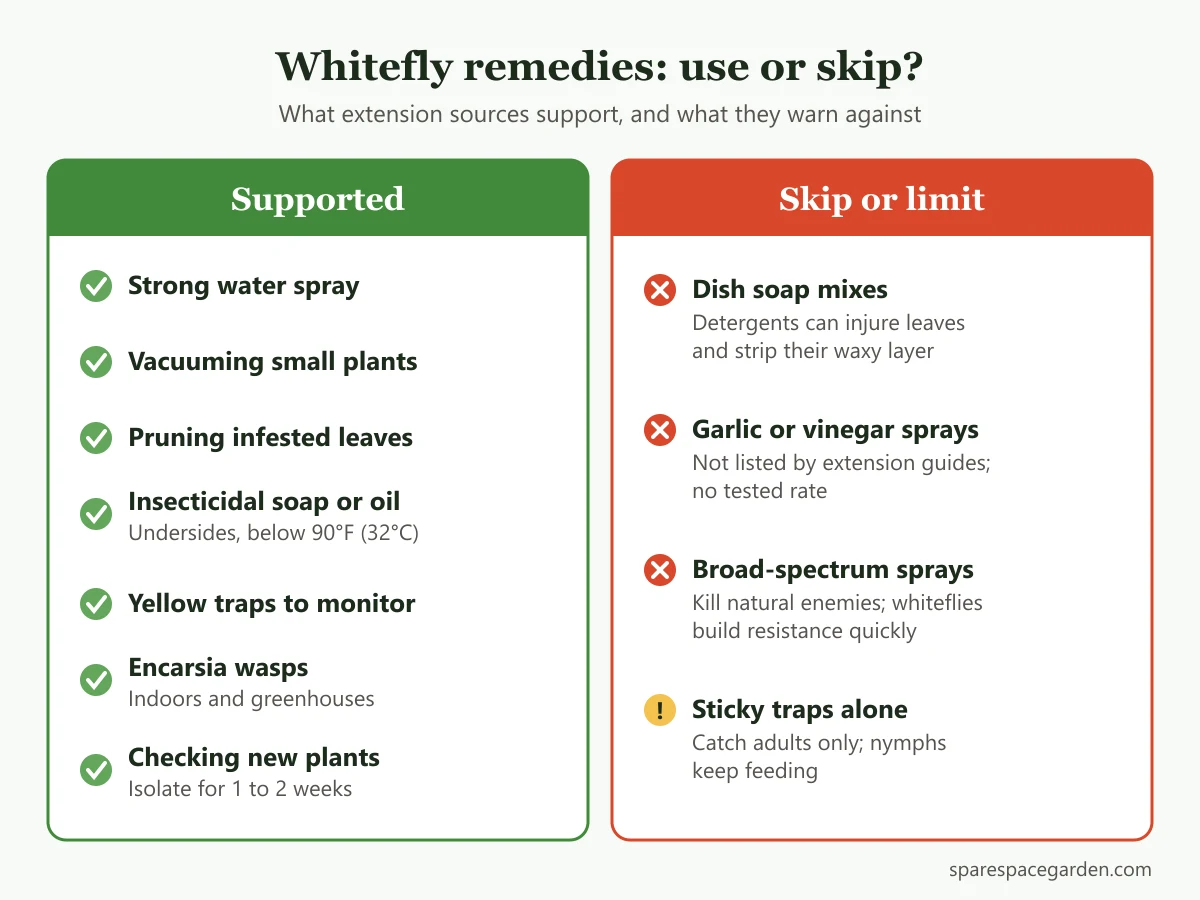 Remedies with extension support on the left, popular ones to skip on the right.
Outdoor predators
Outdoors, wild predators do much of the work. UC IPM lists lacewings, bigeyed bugs, minute pirate bugs and several lady beetles. The University of Maryland Extension notes that predators and parasitoids build up as the season goes on, so early whitefly problems on vegetables may resolve on their own. Keep ants off the plants and avoid dusty conditions, which UC IPM says can kill or disrupt beneficial insects.
Reflective mulch
UC IPM says shiny metallic-coated construction paper or reflective plastic mulch repels whiteflies while plants are small. Lay it down at planting time and remove it once plants are large and summer heat arrives, to prevent overheating. The research behind it comes from vegetable beds, so on a pot it's a modest helper at best: a reflective collar over the soil surface for young transplants.
Prevention: check new plants first
Whiteflies usually arrive on new plants. Colorado State says infestations of whiteflies, scale and mealybugs are almost always established from infested plants, and recommends isolating new plants for 1 to 2 weeks while you watch them. The RHS also advises quarantining new plants so any eggs and nymphs have time to show up.
University of Maryland Extension suggests disturbing the leaves of transplants before you buy them and watching for whiteflies flying up. Tomato, eggplant and cucumber transplants deserve the closest look. Check leaf undersides with a hand lens for the flat, pale nymphs too.
For a windowsill or greenhouse that's badly infested, a host-free break can reset things. UC IPM says removing all host plants from a greenhouse for at least 2 weeks may eliminate problems, as long as whiteflies can't get back in from outside.
Frequently asked questions
What is the best home remedy for whiteflies on plants?
No single remedy works alone. A strong water spray or a hand-held vacuum removes adults, pruning removes leaves loaded with nymphs, and insecticidal soap or oil on leaf undersides treats the rest. Repeat for several weeks, because new adults keep emerging from nymphs already on the plant.
Does dish soap kill whiteflies?
It may kill some, but Colorado State and UConn extension services advise against it. Dish soaps contain detergents that can injure plants and strip the leaf's waxy coating. Use an insecticidal soap labeled for your plant instead, and follow the label.
Do yellow sticky traps get rid of whiteflies?
Not on their own. UC IPM says traps are most useful for monitoring, and they only catch adults while nymphs keep feeding. Use them to judge whether other treatments are working.
Can whiteflies live in the soil?
No. The eggs and nymphs live on the undersides of leaves, not in the potting mix. Tiny flies hovering around the soil surface are more likely fungus gnats; see our guide to getting rid of gnats in potted plants.
Why do whiteflies keep coming back?
Sprays and water reach only the insects present that day, and eggs hatch in five to seven days, according to Colorado State. Indoors, they can breed all year. Keep up treatments every 7 to 10 days, check new plants before bringing them in, and remove old vegetable plants after harvest.