The best container for growing carrots is one that's deeper than the carrot you plan to grow, by about half again. A round carrot 2 to 3 inches long does fine in a pot 6 inches (15 cm) deep, while a long Imperator type wants 12 to 15 inches (30–38 cm) or more. Width matters less than depth, and drainage and a loose, stone-free mix matter more than what the pot is made of.
This guide matches pot depth to carrot type, compares common container materials, and covers the soil, sowing and harvest details that decide whether you pull up straight roots or forked ones.
Quick answer: Pick a container at least 1.5 times as deep as the mature carrot: about 6 in (15 cm) for round types, 7–9 in (18–23 cm) for Chantenay, 10–12 in (25–30 cm) for Nantes and Danvers, and 12–15 in (30–38 cm) or more for Imperator. Any material works if it has drainage holes. Fill it with loose potting mix and thin seedlings to 2–3 in (5–7.5 cm) apart.
How deep a container carrots need
Depth is the one measurement you can't cheat on. NC State Extension's guide to easy container vegetables says containers should be 1.5 times deeper than the mature root, so an 8-inch carrot gets a 12-inch pot. The University of Maryland's Maryland Grows post on carrots in containers uses the same 150% rule, with the example of a 4-inch carrot needing about 6 inches of soil.
A pot that's too shallow doesn't mean failure. Maryland Grows notes that you still get carrots, just smaller ones, and the RHS says shallow pots work if you pull the roots young.
General guidelines differ a little. Oregon State University Extension recommends a shorter variety in a container at least 12 inches (30 cm) deep, while University of Maryland Extension's container guide puts carrots at 8–12 inches (20–30 cm) deep with 4–6 gallons (15–23 L) of mix. The 1.5x rule explains the spread: the right depth depends on which carrot you sow.
Container depth by carrot type
Root lengths below come from University of Maryland Extension's carrot page and University of Illinois Extension, which describe the main carrot types. Where the two differ, the table shows the range.
| Carrot type | Typical root length | Container depth (about 1.5x) | Notes |
|---|---|---|---|
| Round, Paris Market, oxheart | 2–3 in (5–7.5 cm) | 6 in (15 cm) | Recommended for containers and heavy soil |
| Chantenay | 4.5–6 in (11–15 cm) | 7–9 in (18–23 cm) | Wide shoulders, 2–2.5 in (5–6 cm) across |
| Nantes | 6–7 in (15–18 cm) | 10–12 in (25–30 cm) | Cylindrical with a blunt tip |
| Danvers | Up to 7 in (18 cm) | 10–12 in (25–30 cm) | Conical; gets fibrous with age |
| Imperator | 7–10 in (18–25 cm) | 12–15 in (30–38 cm) or more | Long and slender; hardest to fit in a pot |
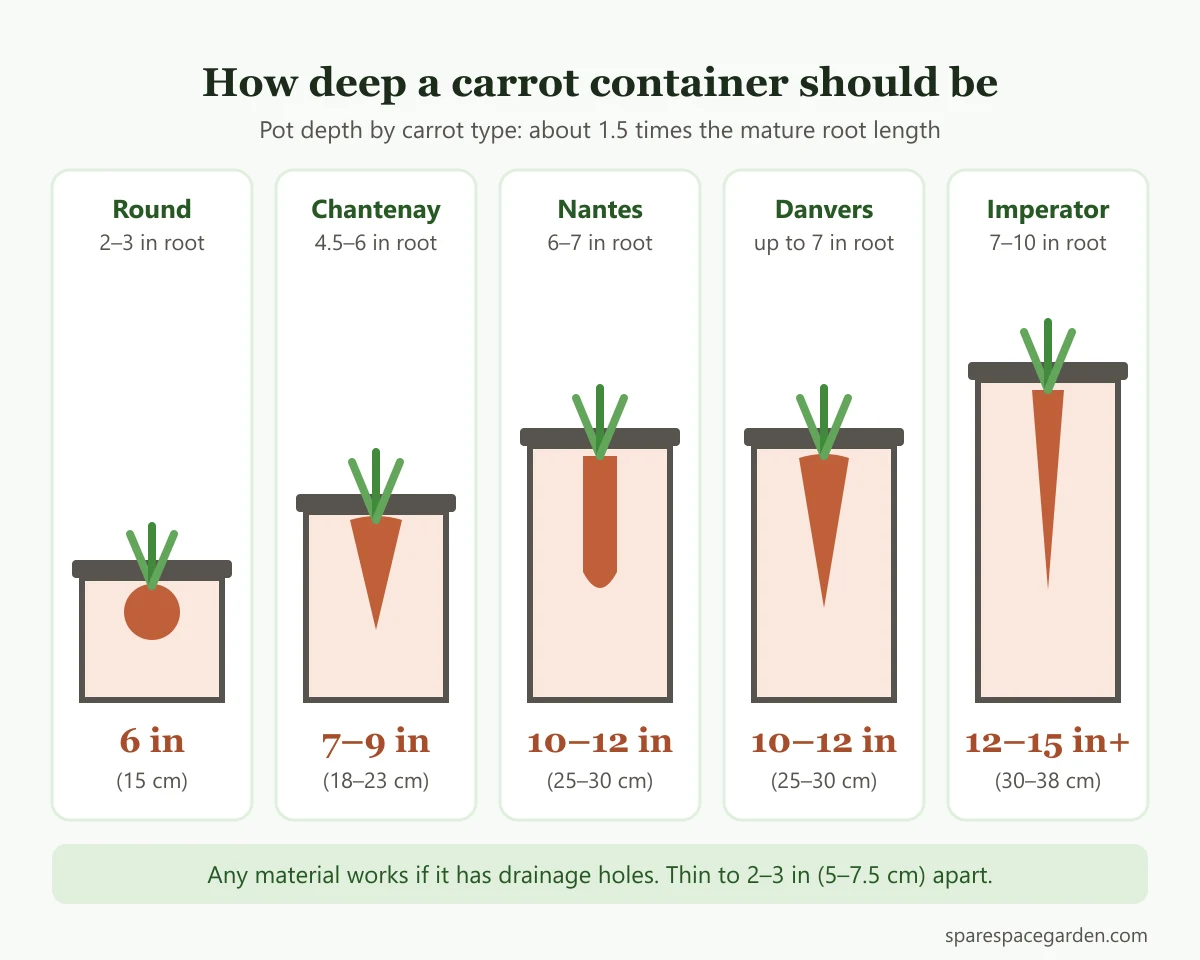 Container depth for each carrot type, using the 1.5x rule.
Round types technically need only 3 to 4.5 inches of mix by the formula, but a 6-inch pot holds more water and dries out less often. Short types are also more forgiving. NC State and Maryland Grows both suggest 'Thumbelina' and 'Short'n Sweet' for containers, and Maryland Grows adds Chantenay types.
Width and spacing: how many carrots fit
Width decides how many carrots you harvest, not how well each one grows. University of Illinois Extension recommends thinning to about 2 inches (5 cm) between plants, the RHS carrot guide aims for 5–7.5 cm (2–3 in), and Virginia Cooperative Extension lists 2–3 inches for carrots in containers. NC State warns that crowded plants don't develop wide roots.
At 2 inches apart, each carrot uses about 4 square inches (26 cm²) of surface. A round pot 12 inches (30 cm) across has a little over 110 square inches, so it holds roughly two dozen carrots at that spacing, or about a dozen at 3 inches.
Volume matters too. Virginia Cooperative Extension lists a 1-quart (about 1 L) container as the minimum for carrots, which works for a few baby carrots on a windowsill. For a real harvest, Maryland Extension's 4–6 gallons (15–23 L) is a better target, because a bigger body of mix stays moist longer between waterings.
Choosing the best container for growing carrots: materials compared
Carrots aren't fussy about material. What changes is how fast the mix dries out, how hot it gets in sun, and how long the container lasts. University of Maryland Extension's guide to container types notes that porous materials such as clay and wood dry out faster than plastic or metal.
| Container | Strengths | Drawbacks | Good fit for |
|---|---|---|---|
| Plastic pots and troughs | Light, cheap, hold moisture well | Plastic not made for outdoor use turns brittle; dark colors heat up | Most balconies and patios |
| Terracotta (unglazed clay) | Heavy and stable in wind | Porous, so it dries out faster; can crack in frost | Cool, damp climates |
| Fabric grow bags | Light, drain freely, fold flat for storage | Breathable sides lose water quickly | Growers who can water daily |
| Wooden boxes and crates | Can be built deep and long | Dry faster than plastic; rot over time | Long troughs with several rows |
| 5-gallon (19 L) buckets | Cheap, tall shape suits carrots | Need drilled holes; must never have held chemicals | One deep pot for Nantes or Imperator |
Plastic is the practical choice for most small spaces. The RHS points out that it's lighter than terracotta and holds moisture better. Pick a light color if the pot sits in full sun: Maryland Extension warns that dark containers get hot enough to injure young roots.
Terracotta works, but plan on watering more often. The RHS says unglazed clay loses moisture faster than other materials and recommends frost-proof pots, not just frost-resistant ones, if you leave them out in winter.
Fabric grow bags behave like porous pots. Water escapes through the sides as well as the base, so they dry out quickly on a hot balcony, but they rarely stay waterlogged. If you already use them for crops like potatoes in grow bags, a deep bag is a simple way to fit long carrot varieties.
Wooden boxes can be built to any size. Virginia Cooperative Extension names redwood and cedar as the most rot-resistant woods and says never to use wood treated with creosote or pentachlorophenol. The RHS suggests lining crates with an old compost bag, with holes punched in the base, to make them last longer.
Buckets are a cheap way to get depth. Maryland Extension lists 5-gallon plastic buckets among containers worth reusing, and Virginia Cooperative Extension says any container must never have held products toxic to plants or people. A bucket is usually taller than it is wide, so measure the inside depth before you choose a variety.
For most balconies, the best container for growing carrots is a light-colored plastic pot or trough, or a fabric bag, deep enough for your chosen type. Terracotta and wood are fine if you water often.
Drainage: the holes matter more than the material
Even the best container for growing carrots fails if water can't leave it. Maryland Extension says all containers except self-watering types need holes or slits in the bottom, and that adding gravel or broken pot shards does not improve drainage. Drill extra holes in buckets and plastic boxes if the base has only one or two.
The RHS suggests raising pots on bricks or pot feet so the holes stay clear, and removing saucers before winter so pots don't stand in water. Virginia Cooperative Extension recommends filling containers to within 1–2 inches (2.5–5 cm) of the top, which leaves room to water without washing seed over the rim.
Tip: If you can't water every day, a self-watering container for vegetables keeps moisture steady from below. Even moisture is exactly what carrots need to avoid split roots.
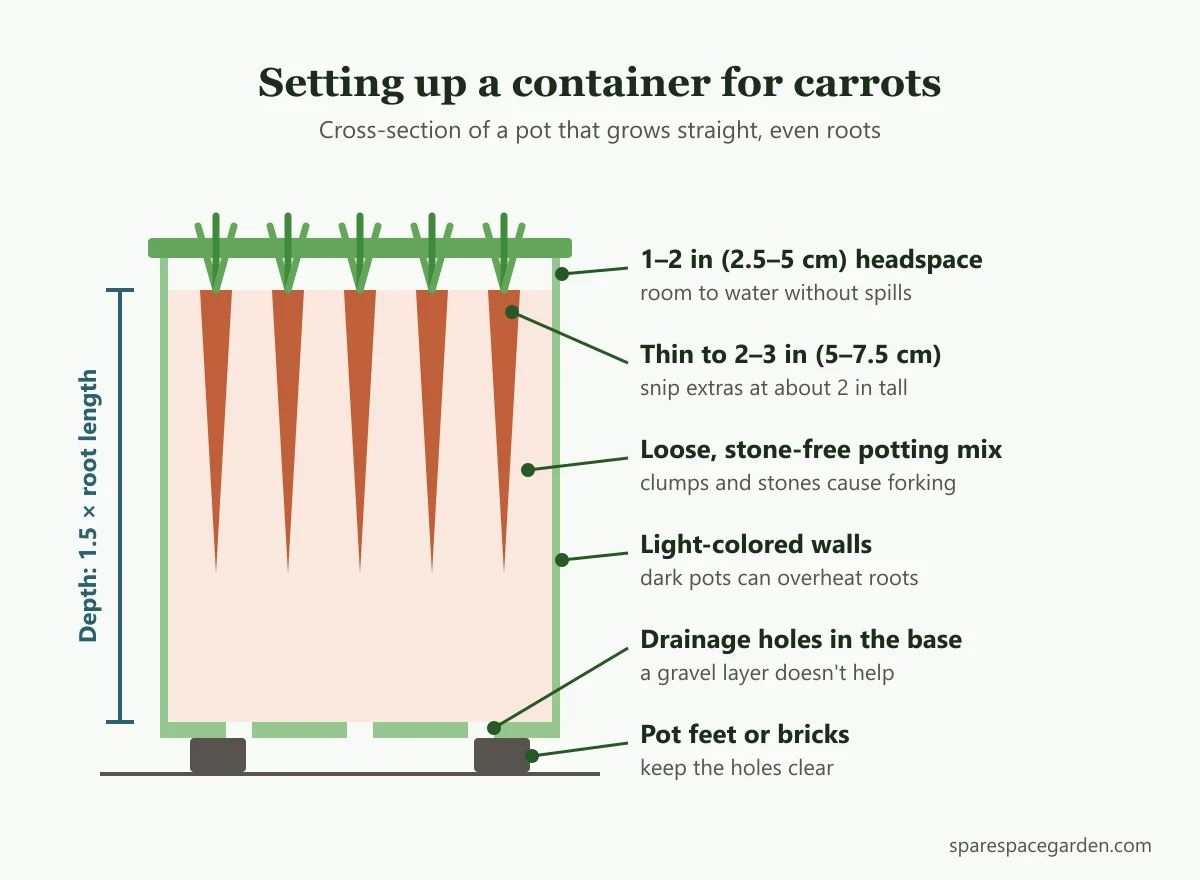 What a well-set-up carrot container looks like in cross-section.
Soil texture: why container carrots fork
Forked, twisted carrots usually point to something in the way. Illinois Extension says rocks, clods and debris cause misshapen roots, and Maryland Extension calls for deep, loose, well-drained soil free of those obstructions. The RHS adds that stony or heavy soil distorts long-rooted carrots, while short, round types tolerate it better.
Containers make this easy to fix. Oregon State recommends commercial potting soil rather than soil dug from the ground, and Maryland Grows suggests a good, loose potting mix kept moist but not soggy. A few habits help:
- Break up any clumps by hand as you fill the pot, and pick out bark chunks or old roots.
- Don't fill the bottom of a deep pot with garden soil to save mix; the roots will reach it.
- Firm the mix gently, but never pack it down.
If you're mixing your own, see how to make potting soil. Our guide to the best potting soil for vegetables explains what to look for on a bag.
Sowing, thinning and harvesting carrots in pots
Once the container is ready, carrots need little more than steady water and patience. Maryland Extension recommends at least 6 hours of direct sun, with 8–10 hours preferred.
- Sow at the right time. Maryland Extension says to plant once the soil reaches at least 45°F (7°C). For a fall crop, sow 10–12 weeks before your first frost.
- Sow thinly and shallowly. Cover seed ¼–½ in (6–13 mm) deep, according to Maryland and Illinois Extension; the RHS gives about 1 cm (½ in). In a pot you can scatter seed across the surface instead of sowing rows, as Maryland Grows suggests.
- Keep the surface moist. Illinois Extension notes that carrots can take up to three weeks to germinate and come up unevenly, and a dry crust stops seedlings from breaking through.
- Thin at about 2 inches tall. Snip extra seedlings with scissors rather than pulling them, which disturbs the roots you keep.
- Water evenly, then ease off near harvest. Illinois Extension links too much water close to harvest with cracking, and the RHS says big swings in moisture cause splitting. Cover exposed shoulders with mix to stop them turning green.
- Harvest by size, not the calendar. Maryland Extension gives 65–75 days from seed for most carrots, and Virginia Cooperative Extension gives 65–80 days. Illinois says roots can be pulled once they're at least ½ inch (1.3 cm) across.
Watch out: In regions with carrot fly, the RHS advises covering the whole crop with insect-proof mesh. Sowing after mid-May avoids the first generation in the UK.
Illinois Extension also suggests sowing a few radish seeds with carrots to mark where they are, since radishes sprout fast. See our guide to growing radishes in containers for that crop on its own.
Frequently asked questions
Can you grow carrots in a 5-gallon bucket?
Yes. A 5-gallon (19 L) bucket falls within the 4–6 gallons Maryland Extension suggests for carrots. Drill drainage holes, use a bucket that never held chemicals, and choose a variety whose root is no longer than about two-thirds of the bucket's inside depth.
How deep should a container be for carrots?
Use about 1.5 times the length of the mature root, the rule given by NC State Extension and Maryland Grows. That works out to about 6 inches (15 cm) for round types and 12 inches (30 cm) or more for Nantes, Danvers and Imperator carrots. Oregon State's general advice is a short variety in a pot at least 12 inches deep.
Are fabric grow bags good for carrots?
They work well if you can water often. Like clay pots, they lose water through their sides, so they dry out faster than plastic in sun and wind. The upside is that they rarely sit waterlogged and are easy to move or store.
What are the best carrot varieties for containers?
Short types are the safest choice. Maryland Grows names 'Thumbelina', 'Short'n Sweet', 'Little Finger' and Chantenay types, and Virginia Cooperative Extension also recommends 'Little Finger'. Round Paris Market types fit the shallowest pots.
Why are carrots in containers forked or split?
Forking usually comes from clumps, stones or debris in the mix, so sieve or break up the mix before sowing. Splitting comes from uneven watering, especially a heavy soak after the pot dried out. Keep moisture steady through the season, then water a little less as harvest nears, as Illinois Extension advises.