Composting in an apartment is very doable once you pick a method that fits your space. A worm bin turns scraps into finished compost in a cupboard, a sealed bokashi bucket ferments almost any food waste on the counter, a small tumbler works on a balcony, and a city drop-off takes everything off your hands.
None of these should smell bad when they're run properly. The trick is matching the method to how much room you have, what you eat and where the finished material will go.
Quick answer: For no outdoor space, choose a worm bin (finished compost in about 3–6 months) or bokashi (about 2 weeks of fermenting, then 2–4 weeks in soil to break down). With a balcony, a small tumbler takes 3–6 months. If you just want scraps out of the trash, a municipal drop-off is the simplest option.
Composting in an apartment: comparing the main methods
Each method does a different job. Worms and tumblers make finished compost. Bokashi makes a fermented "pre-compost" that still has to break down in soil. A drop-off program does the composting for you at a larger site.
| Method | Space needed | Smell when run well | Accepts meat and dairy? | Time to usable material | Running cost |
|---|---|---|---|---|---|
| Worm bin | Under a sink or in a closet | None to earthy | No | 3–6 months | Bedding and the worms at the start |
| Bokashi bucket | Kitchen counter or cupboard | Sour, pickle-like inside the bin | Yes, plus small bones | About 2 weeks fermenting, then 2–4+ weeks in soil | Ongoing bran |
| Balcony tumbler | A balcony or patio corner | Earthy | No | 3–6 months | Mostly the tumbler itself |
| City drop-off | A lidded caddy | Depends on how often you empty it | Often yes, check local rules | Not your job | Usually free |
The timings come from the sources linked in each section below. Real results vary with temperature, scrap size and how carefully the bin is managed.
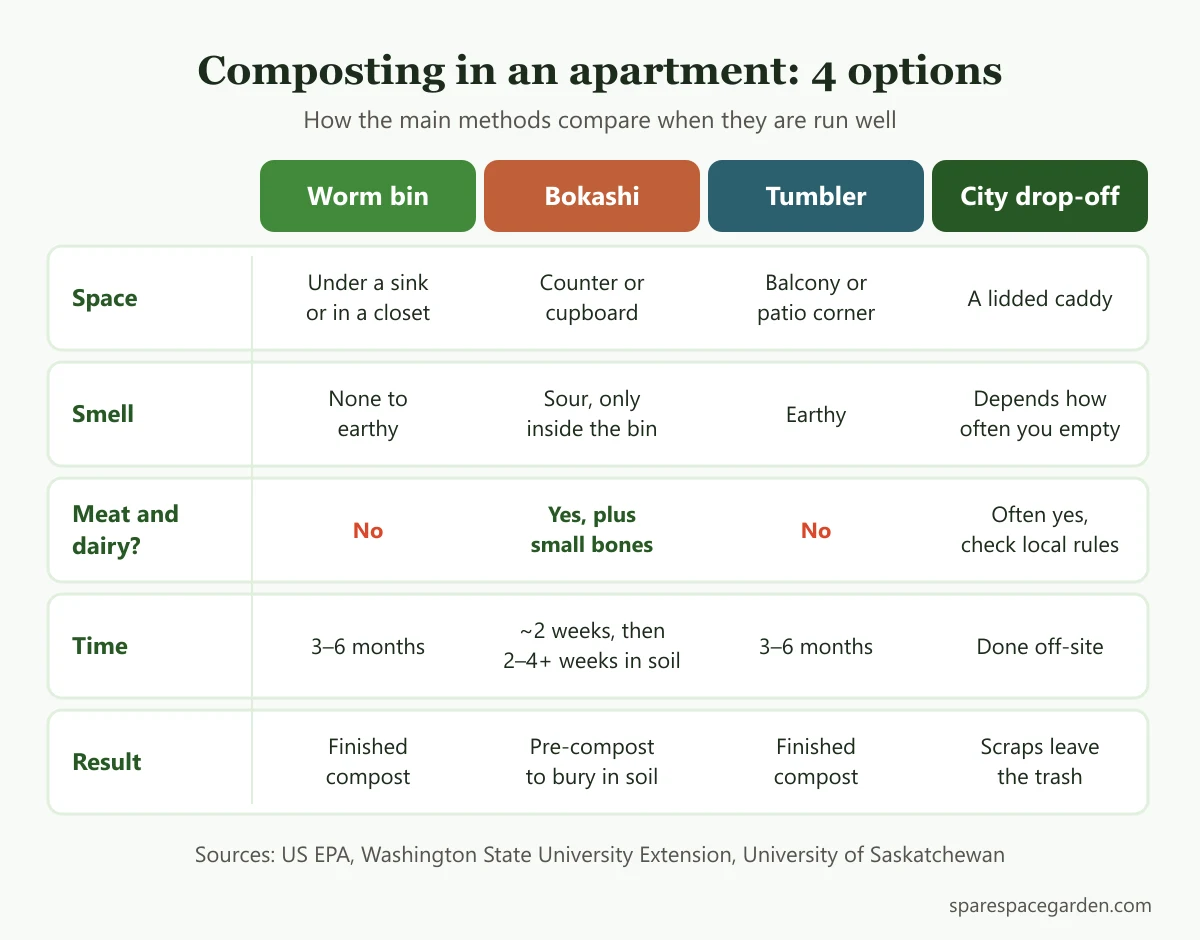 The four main apartment options side by side.
Worm bins: finished compost under the sink
A worm bin is the only indoor method that turns scraps into finished compost you can mix straight into pots. The US EPA's home composting guide says vermicomposting can be done under a sink, in a closet or in a basement, and that a properly maintained bin shouldn't give off odors or attract pests.
The EPA's starting numbers are simple. Begin with about 1 pound (0.45 kg) of worms, roughly 1,000 of them, keep the bin between 59 and 77°F (15–25°C), and expect to harvest compost after 3 to 6 months. Worms eat about a quarter of their body weight a day, so a small bin handles a modest household's fruit and vegetable scraps, not everything.
Worm bins have limits. They don't suit meat, dairy or oily food, and they need some care with moisture and bedding. Our guide to indoor worm composting covers the setup, and you can build a DIY worm composter from two bins for very little money.
Bokashi: fermenting scraps in a sealed bucket
Bokashi isn't composting in the usual sense. It's an airtight fermentation. You layer food scraps with bran that carries helpful microbes, press out the air and seal the lid. The microbes pickle the food instead of rotting it, which is why a good bin smells sour rather than putrid.
What bokashi accepts
This is where bokashi stands out. Washington State University Extension and NC State Extension both say it handles nearly all kitchen waste, including fruit and vegetable scraps, cooked food, dairy, meat and small bones. Those are the items the EPA advises keeping out of an ordinary compost pile because they can attract animals.
WSU does advise going easy on very wet foods such as soups, sauces and lots of juicy fruit, and not pouring liquids in, because extra liquid upsets the bin.
How to run a bokashi bin
- Add scraps in layers. Chop large pieces and spread a handful of bokashi bran over each new layer.
- Press it down. Squash each addition to push out air, then close the lid tightly.
- Drain the liquid. Use the spigot every few days, or daily if odors start. WSU says this liquid can be used diluted, though it gives no fixed ratio, so start weak.
- Let the full bin sit. Once full, leave it sealed for about two weeks (WSU gives 10–14 days). A second bucket lets you keep collecting meanwhile.
- Check the result. WSU describes a good batch as sour, tangy or vinegar-like. White mold is a healthy sign; green, black or blue mold means air got in.
WSU suggests keeping the bin at 65–85°F (18–29°C), which suits most kitchens.
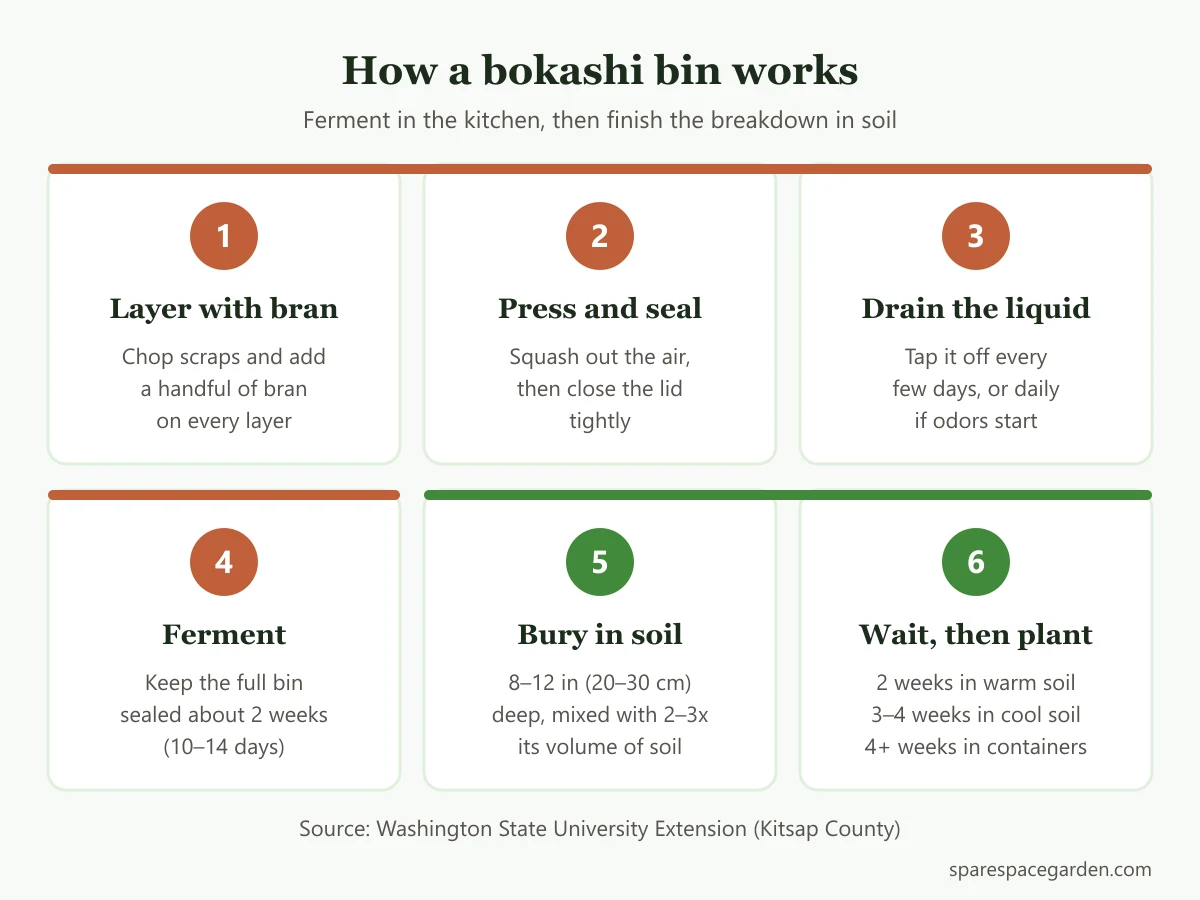 How bokashi works, from bucket to soil.
Finishing bokashi in soil or containers
Fermented bokashi isn't finished compost. WSU is clear that it must be buried in soil or added to another compost system to complete the breakdown, and it advises never placing it right against roots or trunks.
WSU's guidance for burying it:
- Dig down 8–12 in (20–30 cm). NC State says at least 8 in (20 cm) deep to avoid attracting animals.
- Spread the material 1–2 in (2.5–5 cm) thick and mix it with at least 2–3 times its volume of soil.
- Wait about 2 weeks in warm, active soil before planting, 3–4 weeks in cool soil, and 4 weeks or more in containers.
With no garden, use a "soil factory": a spare lidded tub or large pot filled with 1 part bokashi to 3 parts old potting mix, kept moist but not wet for 3–6 weeks. WSU describes this holding method, and it's a good way to recycle tired mix (see can you reuse potting soil).
Tip: Most bokashi smells come from a poor seal. WSU suggests keeping the lid gasket clean, and pressing each layer down hard so there are no air pockets.
Balcony tumblers and small bins
A sealed tumbler is the closest thing to a garden compost pile for a balcony. It's a drum on a stand that you turn by hand, which mixes and aerates the contents without a fork.
The University of Saskatchewan's gardening page on tumbling bins suggests about 40% green material (kitchen scraps, plant trimmings) to 60% brown (dead leaves, shredded paper), a small scoop of soil or finished compost after each addition, and turning every week or so. It puts the time to finished compost at 3–6 months, depending on particle size and materials.
A few drawbacks matter more on a balcony:
- Single-chamber tumblers mix old and new. Saskatchewan notes it's hard to get finished compost unless the unit has two compartments, so a dual-chamber model is worth it.
- Cold stops it. Contents can freeze in winter and the lid can freeze shut.
- No meat or dairy. Saskatchewan's list of kitchen waste excludes meat, bones, dairy and grease.
- Browns run out. Keep a bag of dry leaves or shredded paper on hand. Apartment dwellers often rely on shredded cardboard.
Before buying, check your balcony's sun, weight limits and your lease. The guide to starting a balcony vegetable garden explains why load and drainage matter up there.
Municipal and community drop-off programs
If you only want scraps out of the trash, a drop-off program is the easiest route. Many US cities now run them for residents without curbside food scrap collection. Kirkland, Washington, for example, offers drop-off sites for apartment and condo residents whose building has no compost cart, accepts bones, shells, meat and dairy, and bans plastic bags.
Rules vary a lot between programs. Some accept compostable bags and some want loose scraps only. Some take meat and some don't. Search your city or county name plus "food scrap drop-off," and also ask nearby community gardens, which sometimes take scraps.
What about electric countertop "food recyclers"?
Countertop machines that heat, dry and grind scraps overnight are often sold as composters. The output is small, dry and low on smell, but it isn't finished compost.
CalRecycle, California's recycling agency, says plainly that dried food waste is not compost: compost comes from a process that takes weeks or months, while drying takes a day or less. It also warns that dried material can soak up water again, bringing back odor and pest problems. That guidance is written for commercial food waste dehydrators, but home units work on the same drying-and-grinding principle.
Treat the output as a pre-compost. Add it to a worm bin, a tumbler, a drop-off bin if your program allows it, or bury it in soil to finish breaking down. Weigh the price and the electricity against what you'd do with the material afterward.
Keeping smells, pests and your landlord happy
Most apartment composting problems come down to moisture, air and storage. Fix those and the neighbors never know.
Odor and pests
| Problem | Likely cause | Fix |
|---|---|---|
| Rotten or ammonia smell in a worm bin or tumbler | Too wet, too many scraps, not enough browns | Add shredded paper or dry leaves, feed less, turn or fluff |
| Rotten or sulfur smell in bokashi | Air getting in, too little bran, liquid building up | Press down firmly, add more bran, drain more often |
| Green, black or blue mold in bokashi | Air exposure | Add bran and compress; if it takes over, discard and restart |
| Fruit flies around the caddy | Exposed scraps, a loose lid | Use a tight lid, empty often, freeze scraps between drop-offs |
| Pests at a balcony bin | Meat, dairy or grease added | Keep those for bokashi or drop-off only |
The EPA's backyard guidance is useful here too: cover food scraps with brown material and keep about two to three parts browns to one part greens to discourage rodents.
Tip: A freezer bag or lidded container for scraps stops odors and fruit flies while you collect enough for the bin, the drop-off or a full bokashi layer.
Lease and building rules
Read your lease and any building or HOA rules before setting anything up on a balcony. Many limit what can be stored outside, and some ban items that could attract pests. Tumblers and large bins also add weight, and a full one can be heavy.
Indoor methods rarely cause issues, but a short note to your landlord avoids surprises during an inspection. Keep fire exits, sprinkler heads and balcony drains clear, and never drain bokashi liquid or bin runoff over the railing.
Frequently asked questions
Does composting in an apartment smell?
Not when it's run well. The EPA says a properly maintained worm bin shouldn't give off odors, and a healthy bokashi bin only smells sour when you open it. Strong smells usually mean too much moisture, too little brown material or air getting into a bokashi bucket.
Can I compost in an apartment with no balcony?
Yes. A worm bin fits under a sink or in a closet, and a bokashi bucket sits on a counter or in a cupboard. The catch with bokashi is that you need somewhere to bury the fermented material, such as a large spare pot of old potting mix or a community garden plot.
How should you use compost from an apartment bin?
Mix it into potting mix rather than planting straight into pure compost. Our guide on how to make potting soil gives proportions. Bokashi has to sit in soil first: WSU suggests 4 weeks or more in containers before planting.
Can I put meat and dairy in apartment compost?
Only in bokashi or a drop-off program that accepts them. The EPA advises keeping meat, fish, bones, dairy and fats out of ordinary compost because they can attract animals, and worm bins and tumblers are run the same way.
What is the cheapest way to compost in an apartment?
A homemade worm bin or a free city drop-off program. Bokashi has an ongoing cost for bran, and tumblers and electric machines cost more up front.