The best container for growing lettuce indoors is wide and shallow rather than deep. Lettuce roots stay near the surface, so a tray 3 to 4 inches (8–10 cm) deep grows baby leaves, and 6 inches (15 cm) or more is plenty for full-size loose-leaf plants. What matters more indoors is drainage, a saucer that protects your windowsill, and enough light.
This guide compares trays, pots, window boxes and simple hydroponic jars, then covers spacing, light and harvesting so the container you pick actually produces salads.
Quick answer: For cut baby leaves, use a tray or box 3–4 in (8–10 cm) deep. For full-size loose-leaf lettuce, pick a container at least 6 in (15 cm) deep and about 12 in (30 cm) wide, and space plants about 6 in (15 cm) apart. Every soil container needs drainage holes and a saucer indoors. Under lights, run them 14–16 hours a day, 6–12 in (15–30 cm) above the leaves.
How deep and wide a lettuce container needs to be
Lettuce needs less depth than almost any other vegetable. The University of Vermont Extension's guide to growing greens indoors in winter says shallow containers about 3 to 4 inches deep are fine for greens, because their roots are shallow. University of Maryland Extension puts salad greens in its smallest container group: 1–3 gallons (3.8–11 L) and 4–6 inches (10–15 cm) deep.
For bigger plants, go a little deeper. Colorado State University Extension's container salad greens guide recommends a tray, pot or window box at least 18 inches (46 cm) across and 6 to 12 inches (15–30 cm) deep, noting that deeper containers give roots more room and dry out more slowly. The RHS suggests containers at least 30 cm (1 ft) wide.
Width decides how many plants you get. Depth mostly decides how often you water.
| What you want to harvest | Container depth | Width and spacing | Good containers |
|---|---|---|---|
| Baby leaves, cut young | 3–4 in (8–10 cm) | Sow about ½ in (1.3 cm) apart | Seed trays, shallow boxes |
| Full-size loose-leaf | 6 in (15 cm) or more | Plants about 6 in (15 cm) apart | Pots 12 in (30 cm) wide, window boxes |
| Butterhead, romaine, other hearting types | 6–12 in (15–30 cm), deeper end preferred | Plants about 12 in (30 cm) apart | One plant per 12 in pot, long troughs |
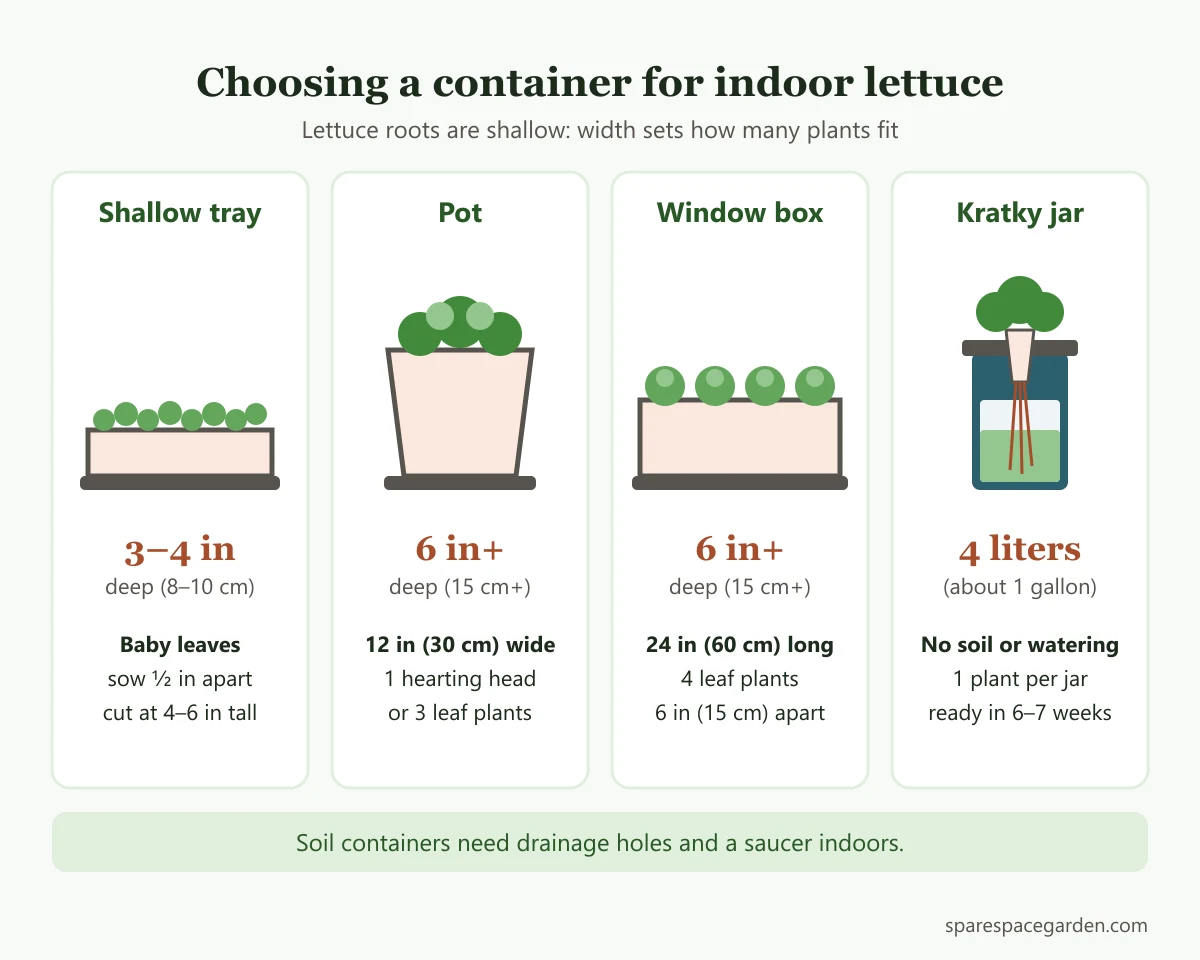 Four container options for indoor lettuce and what each one suits.
Choosing the best container for growing lettuce indoors
Trays, pots, window boxes and jars all work, so the best container for growing lettuce indoors depends on how you plan to harvest. They differ in how many plants they hold, how often you water, and how much space they take on a sill or shelf.
Shallow trays and boxes for baby leaves
A seed tray or shallow box is the cheapest way to grow cut-and-come-again salad. Colorado State suggests sowing densely, about ½ inch apart, because the plants won't grow to full size. A tray fits neatly under a single grow light, and the whole surface gets even light.
The downside is water. A 3-inch layer of mix dries quickly in a warm room, so check it daily.
Pots for single full-size heads
A round pot about 12 inches (30 cm) across holds one hearting lettuce or a few loose-leaf plants. Pots are easy to turn toward the window, which matters: University of Illinois Extension advises rotating containers every few days when light comes from one side, because plants lean toward it.
Window boxes and troughs for windowsills
A long, narrow box makes the best use of a sunny windowsill. A 24-inch (60 cm) box holds about four loose-leaf plants in a row at 6-inch spacing, or two staggered rows if it's wide enough. Choose one with holes and a matching drip tray; many decorative indoor boxes have neither.
Kratky jars and bins for soil-free lettuce
The Kratky method grows lettuce in a covered container of nutrient solution, with no soil, pump or electricity. It's covered in detail below. It's the tidiest option indoors, since there's no potting mix and no runoff.
| Container | Strengths indoors | Drawbacks | Best for |
|---|---|---|---|
| Shallow tray or box | Cheap, fits under one light, quick baby leaves | Dries out fast; needs daily checks | Cut-and-come-again mixes |
| Pot, about 12 in (30 cm) wide | Easy to rotate and move | Holds few plants | One head or a few leaf plants |
| Window box or trough | Uses a long sill well | Needs a drip tray; can be heavy when wet | Rows of loose-leaf lettuce |
| Kratky jar or bin | No watering, no soil mess | Needs hydroponic nutrients and a dark container | Leaf and small head types |
The Kratky jar option: lettuce without soil
University of Hawaii researcher B.A. Kratky developed this method for lettuce. In his paper on non-circulating hydroponic methods for lettuce, the simplest version is a darkened 4-liter (about 1 gallon) plastic bottle, filled to within 4 cm (1.5 in) of the top with nutrient solution. A tapered net pot of growing medium sits in the neck with its lower 3 cm (about 1.2 in) in the solution.
As the plant drinks, the level drops and leaves a moist air gap. The upper roots breathe in that gap while the lower roots take up water and nutrients. Kratky reports leaf and semi-head lettuce ready about 6 to 7 weeks from seeding, with the solution falling 15–25 cm (6–10 in) by then.
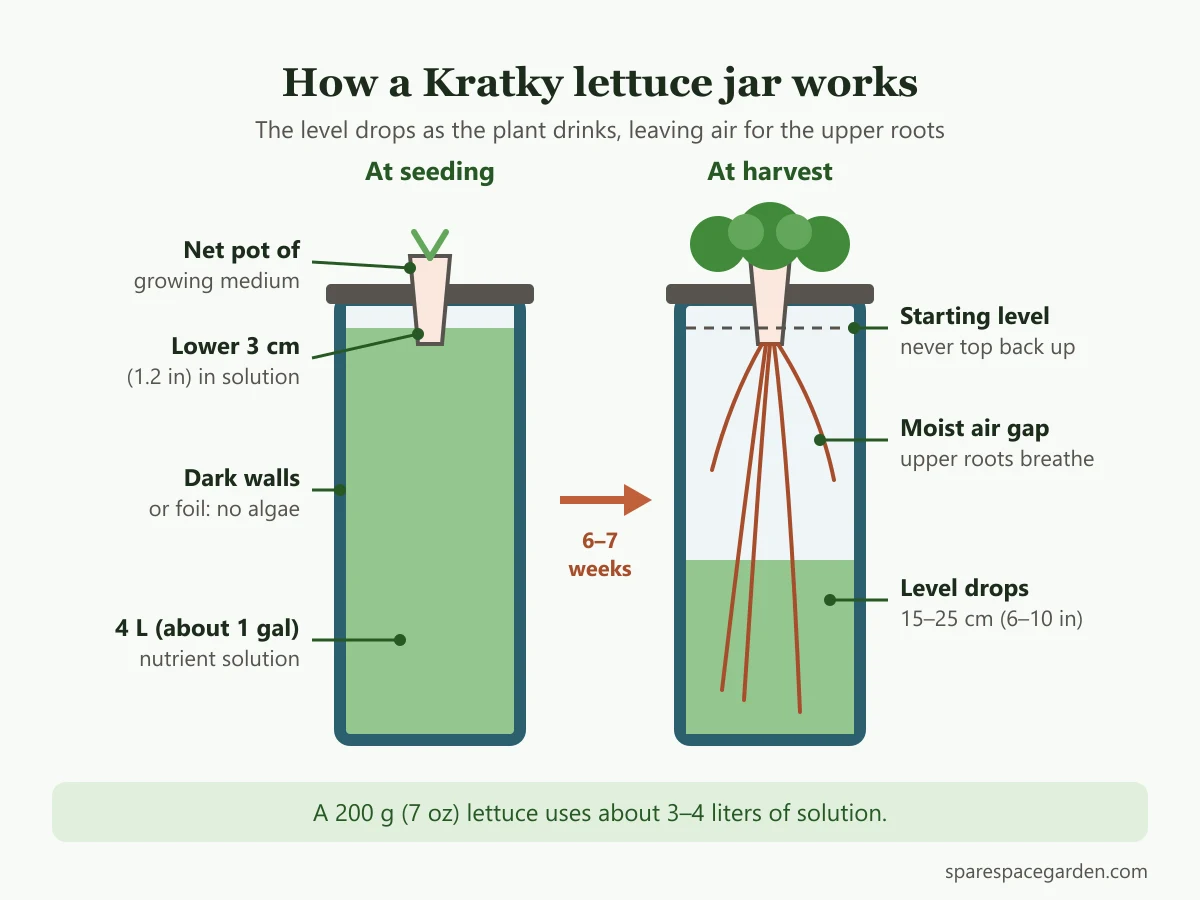 How a Kratky container waters lettuce on its own as the level drops.
Size the container to the plant. Kratky found that a lettuce plant of about 200 g (7 oz) uses roughly 3–4 liters of solution, which is why the 4-liter bottle works. North Dakota State University Extension also suggests a gallon container and a 2-inch net pot for lettuce. A quart mason jar holds only about a quarter of that, so it suits a few weeks of baby leaves. For more plants, Kratky grew 3 or 4 lettuces in a 20-liter (about 5-gallon) bucket with a lid.
A few rules keep it working:
- Block the light. UF/IFAS Extension and NDSU both say to use a lightproof container or wrap a clear one in foil, which stops algae.
- Mix nutrients by the label. NDSU stresses that more is not better.
- Never raise the level. Kratky warns that topping the solution back up over roots growing in the air gap can drown the plant.
Drainage and saucers: protecting floors and roots
Every soil-filled container needs holes in the bottom. University of Maryland Extension says nearly all containers except self-watering types need drainage holes, and that a layer of gravel or pot shards doesn't improve drainage. Illinois Extension gives the same advice for indoor lettuce and herbs.
Indoors, holes mean you also need something to catch the water. Colorado State recommends a tray or dish under the container. Maryland Extension suggests emptying saucers after watering so the pot doesn't sit in water. If you love a decorative pot without holes, set a plain plastic pot with holes inside it and lift it out to drain.
Watch out: Wet mix in a warm, still room invites fungus gnats and white mold on the soil surface. Water when the top feels dry, empty saucers, and see our guides to gnats in potted plants and fungus on indoor plant soil if they show up.
A self-watering container is the exception to the drainage rule, and it's a reasonable choice for full-size lettuce if you're often away.
Container materials compared
Material matters less than size and drainage, but it changes how often you water. Maryland Extension notes that porous materials such as clay, ceramic, concrete and wood dry out faster than plastic or metal.
- Plastic: light, cheap, holds moisture well. The practical choice for trays and window boxes.
- Unglazed terracotta: breathes, so it's forgiving if you tend to overwater, but shallow clay pots dry out fast in a heated room.
- Glazed ceramic: holds water like plastic. Many lack holes, so use one as an outer cover.
- Fabric pots: drain freely but lose water through the sides. Indoors they also need a saucer, and damp fabric can mark furniture.
- Wood boxes: look good on a sill but dry faster than plastic and need a liner or tray.
For the mix itself, use a bagged potting mix, never garden soil or topsoil; Illinois Extension is specific about that. Our guide to the best potting soil for vegetables explains what to look for.
Light is the real limit indoors
Even the best container for growing lettuce indoors won't help in a dim spot. Illinois Extension says lettuce usually needs 6 to 8 hours of bright light a day, and that south-facing windows work well. Colorado State gives 5 to 6 hours and notes that many greens tolerate less, including artificial light.
In winter, most windows fall short. Illinois Extension's setup uses two 40-watt cool-white fluorescent tubes held 6–12 inches (15–30 cm) above the plants for 14 to 16 hours a day. It explains that artificial light is weaker than sun, so you need roughly 2 hours of lamp light for every hour of natural light you're replacing. UVM Extension suggests hanging shop lights on an adjustable chain and keeping them within a few inches of the leaf tops as plants grow.
Tip: Put lights on a plug-in timer. Pale, stretched seedlings mean the light is too far away or not on long enough; our article on leggy seedlings covers the fix.
Temperature matters too. Illinois Extension recommends a room at 70°F (21°C) or below, away from heaters and radiators. Lettuce is a cool-season crop, which is why a cool room or basement shelf with lights often grows better heads than a warm kitchen.
Spacing and cut-and-come-again harvests
Spacing depends on how you plan to harvest. The RHS lettuce guide gives about 15 cm (6 in) between loose-leaf plants and 30 cm (12 in) for hearting types. For baby leaves, sow thickly and cut the whole patch young.
Loose-leaf types suit indoor containers best. Illinois Extension calls them your best bet indoors and says they're often ready to harvest at about 4 weeks; the RHS gives 4–6 weeks for loose-leaf and 10–14 weeks for hearting lettuce.
There are three ways to harvest:
- Pick outer leaves. UVM suggests starting when greens are 3–4 inches (8–10 cm) high, taking outer leaves and leaving the center to keep growing.
- Cut the whole patch. Colorado State says to cut plants at 4–6 inches (10–15 cm) tall, leaving about an inch (2.5 cm) of leafy growth to regrow.
- Cut a head and leave the stump. The RHS says cutting a hearting lettuce about 2.5 cm (1 in) above the base can give one or two smaller later harvests.
Colorado State suggests a half-strength vegetable fertilizer once plants reach 4–6 inches, repeated about every two weeks. For a steady supply, UVM recommends starting a new container every 2–3 weeks. If you're short on time and light, a tray of microgreens grown indoors is ready even faster.
Frequently asked questions
How deep does a container need to be for lettuce indoors?
For baby leaves, 3–4 inches (8–10 cm) is enough, according to UVM Extension. For full-size plants, aim for 6 inches (15 cm) or more; Colorado State recommends 6–12 inches (15–30 cm), and deeper containers dry out more slowly.
Can you grow lettuce in a container without drainage holes?
Only with a system built for it, such as a self-watering pot or a Kratky jar. A normal pot of potting mix with no holes stays waterlogged, which leads to root rot. Use a pot with holes inside a decorative cover instead.
Is a mason jar good for growing lettuce?
A wide-mouth jar works for the Kratky method if you darken it with foil or paint. A quart jar holds about 1 liter, while Kratky found a full-size plant uses about 3–4 liters, so a jar suits baby leaves. Use a container of about 1 gallon (4 L) for a full head.
How many lettuce plants fit in one pot?
At the RHS spacing of about 6 inches (15 cm) for loose-leaf types, a pot 12 inches (30 cm) across holds about three plants. A hearting lettuce needs about 12 inches (30 cm), so plan on one per pot that size.
Do you need grow lights to grow lettuce indoors?
Not always. A south-facing window can supply the 6–8 hours of bright light Illinois Extension recommends in spring and fall. In winter, or in a north-facing room, lights run 14–16 hours a day are usually the difference between a harvest and pale, leggy plants.