You can grow herbs in the kitchen on a bright windowsill or countertop, as long as the pots get enough light and sit away from the stove, oven and heat vents. The rest is choosing herbs you actually cook with, cutting them so they keep regrowing, and treating the pots as part of a food prep area.
This guide covers where to put herbs in a kitchen, what to keep them away from, how to match herbs to your cooking, how to harvest and wash them, pet safety, and which kitchen scraps really regrow.
Quick answer: Give kitchen herbs the brightest spot you have: at least 4 to 6 hours of direct sun, ideally 6 to 8, or a grow light 6 to 12 inches (15 to 30 cm) above the leaves for 12 to 16 hours a day. Keep pots away from the stove, oven, dishwasher vent and heating vents. Grow two or three herbs you use every week, rinse leaves under running water before cooking, and check pet safety before you buy.
Where to grow herbs in the kitchen
Light decides the spot. University of Tennessee Extension says herbs and leafy crops need at least 4 to 6 hours of direct sunlight a day, and Iowa State University Extension puts most herbs at about eight hours, with some managing on six. In many kitchens the only place that comes close is the window over the sink.
Counters are usually dimmer than they look. A pot a few feet back from the glass gets much less light than one on the sill, and the counter under wall cabinets is shaded most of the day. If your window faces the wrong way, our guide to a herb window garden explains how window direction changes what you can grow.
An under-cabinet grow light turns a dark counter into a usable one. Iowa State's guide to growing herbs indoors says to place lights within 6 to 12 inches (15 to 30 cm) of the leaves and run them 12 to 16 hours a day on a timer. If the gap between the light and the leaves is bigger than that, raise the pots on a small stand.
| Kitchen spot | Light | Watch out for | Verdict |
|---|---|---|---|
| Windowsill over the sink | Often the brightest | Splashes of hot or soapy water | Good for small pots |
| Counter beside the window | Bright near the glass | Crumbs and prep clutter | Good on a tray |
| Under wall cabinets | Dim without help | Needs a grow light | Good with a light |
| Next to the stove or oven | Varies | Bursts of heat and grease | Avoid |
| Beside the kettle, toaster or coffee maker | Varies | Hot air and steam jets | Avoid |
| In front of a heating or cooling vent | Varies | Direct hot or cold airflow | Avoid |
| On top of the refrigerator | Usually dark | Hard to reach and check | Avoid |
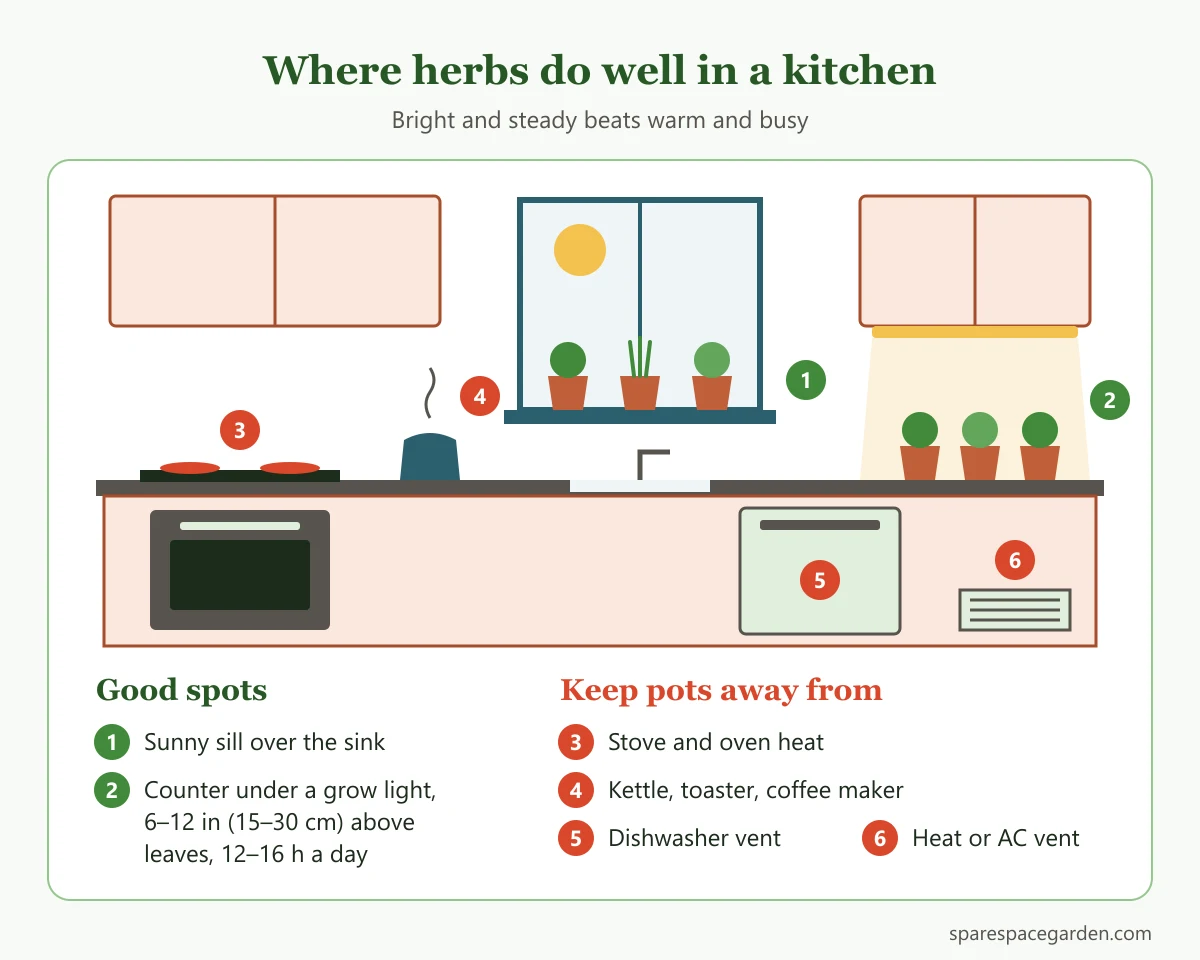 Good and poor spots for herb pots in a typical kitchen.
Heat, steam and drafts: what to keep pots away from
Kitchens have hot spots no other room has. Herbs like moderate, steady conditions: Illinois Extension gives 65 to 70°F (18 to 21°C) by day and 55 to 60°F (13 to 16°C) at night as the range most plants grow best in.
- Stove and oven. Bursts of heat dry a pot out fast and scorch leaves on the side facing the burners. Dry leaves hanging over a gas flame are also a fire risk.
- Heating and cooling vents. UT Extension advises a location that does not get direct airflow from a heating or air conditioning vent. University of Missouri Extension advice, reprinted by the University of Washington's Miller Library, also warns against putting herbs near a radiator or heat vent and says herbs prefer temperatures below 70°F (21°C).
- Kettles, coffee makers and the dishwasher vent. General kitchen humidity is not a problem; Iowa State says herbs tolerate low humidity, and the Missouri advice notes ample humidity helps. A direct jet of steam is different, so keep leaves out of its path.
- Cold glass in winter. Illinois Extension warns that cold air can blacken basil leaves at 50°F (10°C). Pull pots back from the pane on cold nights; our guide to growing herbs indoors year-round covers winter care in detail.
Watch out: Never set a pot on or right beside the cooktop, even when it's off. Someone will turn on the wrong burner sooner or later.
Choose herbs by what you cook
The best kitchen herbs are the ones you'll use every week. Iowa State lists parsley, mint, chives, basil, oregano, cilantro and thyme as the best herbs for indoor growing, with rosemary, sage, lemon balm, marjoram, chervil and bay as next steps because they need more light or attract more pests.
| If you often cook | Grow | Indoor notes |
|---|---|---|
| Pasta, pizza, tomato sauces | Basil, oregano, parsley | Basil wants warmth; keep it off cold glass |
| Tacos, curries, noodle dishes | Cilantro, mint | Cilantro is short-lived; sow a new pot every few weeks |
| Roasts, potatoes, stews | Rosemary, thyme, sage | Sunniest spot; keep the soil on the dry side |
| Eggs, salads, baked potatoes | Chives, parsley | Forgiving and quick to regrow after cutting |
| Tea and drinks | Mint | Give it its own pot and keep it moist |
Start with two or three herbs rather than a full row of pots. If you use one herb heavily, grow two pots of it and alternate cuts, so neither plant gets stripped. Cilantro is the one herb most people need to resow; our guide to growing cilantro in pots explains why it bolts and how to stagger sowings. For a longer comparison, see the best herbs to grow indoors.
Harvesting for cooking without killing the plant
Cut herbs right before you cook with them, and cut in a way that leaves the plant something to regrow from. Iowa State splits herbs into two groups:
- Leafy annuals such as basil and parsley can be cut back hard. Cut just above a leaf or leaf pair and leave about 4 to 6 inches (10 to 15 cm) of stem for regrowth.
- Perennials such as chives, mint, oregano and thyme should be cut more lightly. Take no more than the top one-third of the growth.
A few habits make a small kitchen plant go further:
- Use clean scissors and cut stems rather than tearing.
- Take a little from each pot instead of stripping one.
- Cut parsley's outer stems from the base, and leave the young center to grow on.
- Pinch basil flower buds as soon as they form, as Illinois Extension advises. Our guide on how to harvest basil so it keeps growing shows exactly where to cut.
- Replace tired annuals. Iowa State suggests starting new plants from seed after several harvests.
If you cut more than you need, see how to keep basil fresh after picking.
Keeping kitchen herbs clean and food-safe
Homegrown herbs are still fresh produce, and a pot of soil next to a cutting board needs a little care.
Wash before eating. The FDA's tips for cleaning produce apply to herbs too: wash your hands for 20 seconds with warm water and soap before and after handling, rub produce gently under plain running water, and dry it with a clean cloth or paper towel. The FDA says there's no need for soap or a produce wash.
Keep soil away from food prep. Stand pots on a tray so mix and drainage water stay off the counter, repot at the sink or outdoors rather than on a cutting board, and wipe the area afterward.
Keep pest sprays out of food cabinets. The EPA's storage advice is never to store pesticides in cabinets with or near food, to keep them in their original labeled containers, and to keep them out of reach of children and pets. On herbs you'll eat, try rinsing pests off first; our guide to getting rid of aphids naturally covers gentle options. If you do use a product, choose one labeled for edible plants and follow the label, including any wait before harvest.
Check pet safety. The ASPCA's plant list rates several common kitchen herbs as toxic to dogs and cats, including chives, mint and oregano, while basil and rosemary are listed as non-toxic. For chives, the signs it lists include vomiting and breakdown of red blood cells; for mint, vomiting and diarrhea with large amounts. If you have a cat that climbs counters, keep the toxic herbs on a wall rail or shelf out of reach; our guide to a vertical herb garden indoor setup shows how.
Regrowing scallions and herbs from scraps
Some kitchen scraps really do regrow. Green onions are the most reliable, and a few herbs root from stem cuttings.
Green onions. UF/IFAS Gardening Solutions says to cut off the lower third of the stalks with the roots, stand them in a glass with water until half the stalk is submerged, keep them on a windowsill and change the water every few days. Illinois Extension suggests a shallow dish of water in a sunny window, and a separate Illinois Extension post describes planting them in soil after a quick soak for weeks of regrowth. A UC Master Gardener in Solano County reports water-grown scraps reached full size in about a month in a warm house, and advises against using chlorinated water.
Herb cuttings. UF/IFAS lists mint, marjoram, oregano and sage as herbs you can root in water. Strip the leaves from the lower half of a stem, stand it in water with the remaining leaves above the surface, and expect roots over a few weeks. Move it to potting mix once the roots start to branch.
Supermarket herb pots. A living herb pot is usually crowded. The RHS's guide to dividing potted herbs names chives, coriander (cilantro), basil and parsley, and describes pulling the clump apart into pieces, potting each separately, then watering and keeping them warm and light until they establish.
What doesn't work. Cut leaves with no roots or base, such as a bunch of chives or loose parsley leaves, won't regrow. For a steady supply of green onions beyond scraps, sow seed; see growing onions in containers.
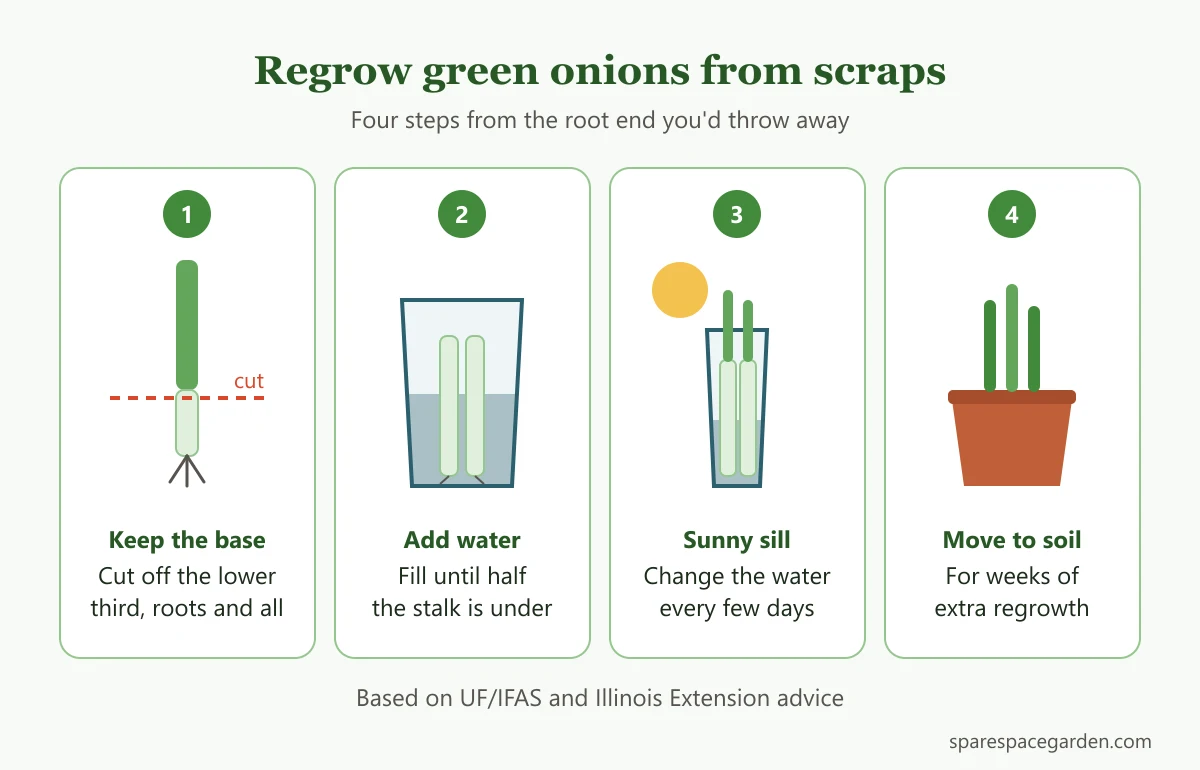 Regrowing green onions from the root end, following UF/IFAS and Illinois Extension.
Compact countertop setups that work
You don't need much counter space. A few small, practical setups are below; for planning herbs across a whole home, including a balcony, see our apartment herb garden guide.
- A tray of three pots by the window. Iowa State recommends one herb per container, appropriately sized pots with drainage, and clay or terracotta, since oversized pots stay wet too long.
- An under-cabinet light strip over a row of pots, on a timer. Keep the plug, timer and cord away from the sink and from drips when you water, and follow the maker's safety instructions.
- A tabletop hydroponic unit. UT Extension mentions tabletop systems with built-in lighting, and simple homemade versions in mason jars or plastic containers. Keep the plug and reservoir away from the sink.
- A microgreens tray. UT Extension calls microgreens some of the quickest crops with the lowest light needs, which suits a dim kitchen; see how to grow microgreens indoors.
Feed lightly. Iowa State suggests an all-purpose fertilizer at half or quarter strength from early spring through summer and none in winter. Follow the label, and store fertilizer away from food as well.
Frequently asked questions
What herbs grow best in a kitchen?
Iowa State lists parsley, mint, chives, basil, oregano, cilantro and thyme as the best herbs for indoors. Pick from that list based on what you cook most, and start with two or three.
Can I keep herbs next to the stove?
It's a poor spot. Heat from burners and the oven dries pots quickly and can scorch leaves, and dry foliage near a gas flame is a fire risk. A bright window or a counter under a grow light works much better.
Do you need to wash homegrown herbs?
Yes. The FDA advises rinsing produce under plain running water, rubbing it gently, then drying it with a clean cloth or paper towel. Soap and produce washes aren't needed.
How many times will green onions regrow in water?
Sources don't give a set number. UF/IFAS and Illinois Extension describe regrowing the root ends in water, and an Illinois Extension post reports weeks of regrowth after planting them in soil. Change the water every few days and use fresh scraps or seed when regrowth slows.
Which kitchen herbs are safe for cats and dogs?
The ASPCA lists basil and rosemary as non-toxic to dogs and cats, and chives, mint and oregano as toxic. If your pet chews plants, keep the toxic ones out of reach and call your vet or a poison control line if you think they've eaten some.