The best container to grow strawberries is wide and fairly shallow: a pot at least 12 inches (30 cm) across and 8 inches (20 cm) deep, or a long trough. Strawberry roots stay near the surface, so extra depth adds little, while extra width means more plants. Strawberry jars, towers and hanging baskets fit more plants into less floor space, but they're harder to keep evenly watered.
This guide compares each container type on plant count, depth and watering, then covers which strawberry types suit pots and how to get containers through winter.
Quick answer: Choose a container at least 12 in (30 cm) wide and 8 in (20 cm) deep, with drainage holes. A 12-inch pot holds 3 or 4 plants spaced about 8 in (20 cm) apart. Long troughs and window boxes yield well; jars, towers and baskets save space but dry out faster at the top. Day-neutral varieties are the easiest choice for containers.
What strawberry roots need from a container
Strawberries need width more than depth. Iowa State University Extension's container guide recommends containers at least 12 inches (30 cm) in diameter and 8 inches (20 cm) deep. University of Maryland Extension's container size chart also lists strawberries at 8 inches deep.
Shape matters as well. University of Wisconsin–Madison Extension says long, narrow containers produce more heavily than round ones, and sets minimums of 12 inches for round containers and 24 inches (60 cm) for rectangular ones.
Spacing sets how many plants fit:
- Iowa State spaces plants about 8 inches (20 cm) apart and says a 12-inch container holds 3 or 4 plants.
- The RHS gives the same 20 cm (8 in) spacing.
- University of Maryland Extension spaces day-neutral plants 5–9 inches (13–23 cm) apart in beds, so compact types can go a little closer.
Whatever you pick, it needs drainage holes. Maryland Extension notes that a layer of gravel or pot shards at the bottom doesn't improve drainage. Fill with a fresh potting mix; our guide to the best soil for strawberries in pots covers what to buy or mix.
The best container to grow strawberries, compared type by type
Each container solves a space problem and creates a watering one. The table sums up how they compare.
| Container | Plants it holds | Size to look for | Watering challenge | Verdict |
|---|---|---|---|---|
| Wide pot | 3–4 in a 12 in (30 cm) pot | 12 in wide, 8 in (20 cm) deep | Low; whole pot dries evenly | Easiest choice for beginners |
| Trough or window box | About 3 per 24 in (60 cm) of length, single row | 24 in long or more, 8 in deep | Low to moderate | Best yield per container |
| Grow bag | Spaced 8 in (20 cm) apart | 8 in deep or more | Fabric sides dry fast in sun | Cheap, light, easy to store |
| Strawberry jar | One per side pocket, plus the top | Large jar with wide pockets | High; top and pockets dry first | Looks good, harder to manage |
| Tower or stacked planter | About 30 in a two-bucket tower | Two 5-gal (19 L) buckets | High; top dries, base stays wet | Most plants per square foot |
| Hanging basket | A few trailing plants | The biggest basket you can hang | Very high; dries and heats quickly | Fine for a few berries where floor space is gone |
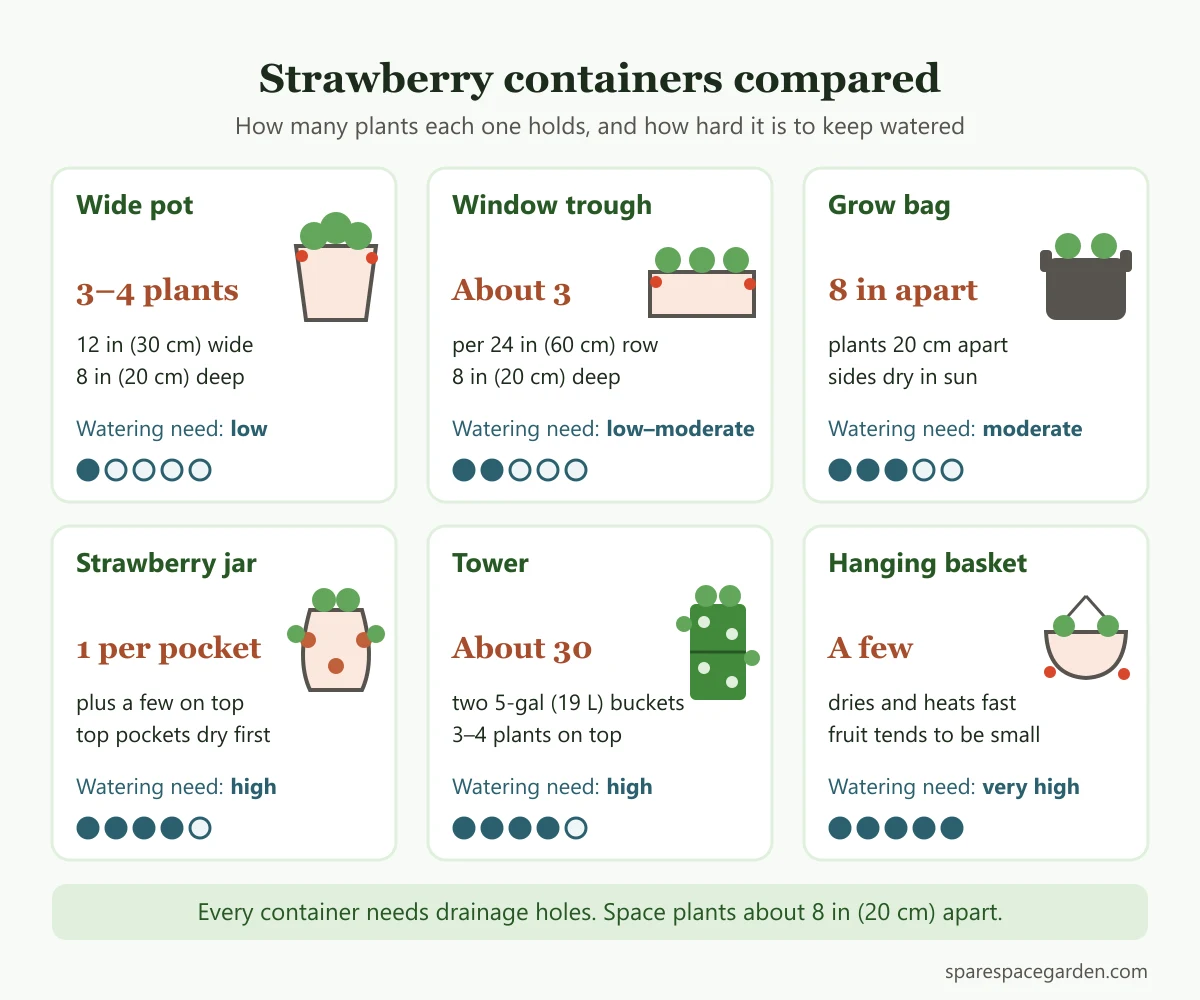 Plants per container and how hard each type is to keep watered.
Standard pots
For most beginners, a plain pot is the best container to grow strawberries in. Everything sits in one body of mix, so it dries evenly and you can tell at a glance when it needs water. Plastic holds moisture longer than unglazed clay; Maryland Extension notes that porous materials such as clay and wood dry out faster than plastic or metal.
Window boxes and troughs
Wisconsin's finding that long, narrow containers produce more heavily makes troughs the best choice for a railing or the edge of a patio. Fruit can also hang over the long rim, away from damp mix.
Grow bags
The RHS lists growing bags among suitable containers for strawberries. Fabric bags are light and fold flat in winter, but their sides lose water as well as the top, so in full sun they need checking more often than a plastic pot.
Strawberry jars (pocket pots)
These urn-shaped pots have planting pockets down the sides. Iowa State likes the extra planting area but notes that upper plants dry out faster. The RHS strawberry guide is blunter: traditional pots with side holes look attractive but make it harder to keep plants healthy and productive. If you use one, choose the largest jar you can find, since a bigger volume of mix holds more water.
Towers and vertical planters
A tower fits the most plants into the least floor space. A UC Master Gardener design builds one from two stacked 5-gallon (19 L) buckets with the bottoms cut out, 2-inch (5 cm) holes drilled about 4 inches (10 cm) apart, and roughly 30 plants, including 3 or 4 on top. The catch is water: it drains downward, so the top dries first while the base stays wetter. See our guide to a vertical vegetable garden for other stacked designs.
Hanging baskets
Baskets keep fruit off the ground, but Iowa State discourages them because they dry out quickly and heat up, which tends to shrink the fruit. If you still want to try, our guide to growing strawberries in hanging baskets covers liners, plant numbers and watering.
Watering: where each container dries out first
The best container to grow strawberries is one you can keep evenly moist. Containers dry out faster than garden soil, and Wisconsin Extension calls regular watering critical. Iowa State says to keep the mix consistently moist, checking regularly and watering when the surface is dry, which can mean daily, or twice daily in summer heat.
The shape of the container decides where problems start:
- Pots, troughs and bags: water until it runs from the holes, then again when the surface feels dry. These are the most forgiving.
- Strawberry jars: Iowa State suggests watering from both the top and the side pockets, because the upper plants dry out first.
- Towers: the UC Master Gardener instructions run a ¼-inch soaker hose vertically through the center of the tower so every level gets water. Without one, use a narrow-spouted watering can to water into each hole.
- Hanging baskets: expect to water more often than anything else on this list.
The RHS recommends watering in the morning and keeping water off the crowns and fruit, which reduces grey mould.
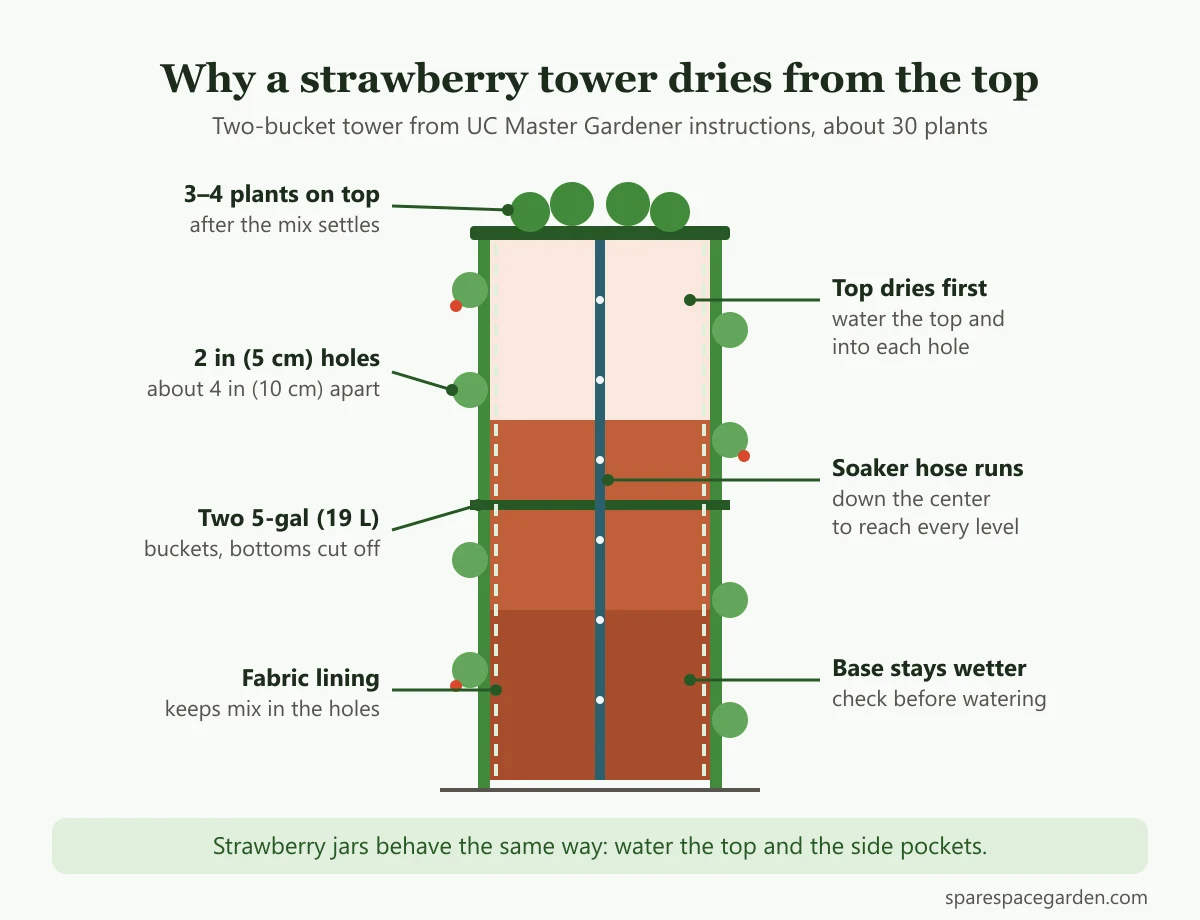 Why towers and jars dry from the top down, and how a center soaker hose helps.
Tip: If you can't water every day, a self-watering container or a trough with a reservoir keeps moisture steady and suits a single row of strawberries well.
Choosing strawberry types for containers
The plant matters as much as the pot. Strawberries come in three groups:
| Type | When it fruits | Container fit |
|---|---|---|
| Day-neutral | Spring through fall, most in late summer and fall | Best: fruits the first season |
| Everbearing | Two main crops, June and late summer | Good |
| June-bearing (summer-fruiting) | One heavy crop over about 2–3 weeks in early summer | Poor: one crop and many runners |
Wisconsin Extension calls day-neutral varieties the easiest for containers, since they produce in the first season and outyield older everbearing types. Iowa State recommends 'Albion', 'Cabrillo', 'Everest' and 'Seascape', and lists 'Ozark Beauty' as an everbearing option. Missouri State University's fruit station adds 'Tribute' and 'Tristar' as day-neutral choices.
Iowa State advises against June-bearers in containers because they fruit once and send out more runners. It also notes that day-neutral plants slow down or stop fruiting above about 80–85°F (27–29°C), then pick up again as fall cools. Remove the first flush of spring flowers so new plants put energy into roots, and keep only one or two runners per plant.
Planting and feeding in containers
Set each plant with its crown level with the surface of the mix. The RHS explains that a buried crown can rot, while one set too high dries out.
Container mixes run out of nutrients quickly. Iowa State recommends a water-soluble all-purpose fertilizer 2 to 3 times a season, ideally right after a harvest flush, at label rates. The RHS suggests a liquid feed every two weeks in the growing season, switching to a high-potassium feed once flower buds form. Our guide to fertilizer for potted plants explains the label numbers.
Watch out: The RHS singles out vine weevil as a particular threat to container strawberries and notes that biological controls can help. Follow the product label if you use one.
Winter protection for potted strawberries
Pots get much colder than the ground. Iowa State's overwintering guide warns that strawberries in jars or other containers left outdoors in winter are likely to be seriously damaged or destroyed, and that temperatures below 20°F (−7°C) can kill flower buds and damage roots and crowns of unmulched plants.
You have three options:
- Move pots into shelter. Iowa State suggests an attached, unheated garage in November. Its general advice for container plants is a spot that stays between 20 and 45°F (−7 to 7°C).
- Bury the pot. For June-bearers kept anyway, Iowa State suggests sinking the container into garden soil and covering it with at least 6 inches (15 cm) of straw, though damage is still likely.
- Start fresh. Iowa State's container guide recommends composting the plants in fall and buying new ones in spring. Day-neutral types are easy to grow this way as annuals.
Even with good winter care, container plants wear out. University of Maryland Extension recommends replacing container strawberries with new plants every three years.
Frequently asked questions
How many strawberry plants fit in a container?
Iowa State says a 12-inch (30 cm) container holds 3 or 4 plants spaced about 8 inches (20 cm) apart. Long troughs fit about 3 plants per 24 inches (60 cm) of length in a single row. A two-bucket tower like the UC Master Gardener design holds around 30.
How deep should a strawberry container be?
About 8 inches (20 cm) is enough, according to Iowa State and Maryland Extension. Strawberry roots stay shallow, so width matters more than extra depth.
Are strawberry jars good for growing strawberries?
They work, but they're harder to manage than a plain pot. The upper plants and pockets dry out first, so water from the top and into the side pockets. The RHS notes that plants in pocket pots are harder to keep healthy and productive.
Can strawberries in pots survive winter outside?
In cold regions, usually not without help. Iowa State warns that containers left outdoors are likely to be badly damaged and that temperatures below 20°F (−7°C) harm roots and crowns. Move pots into an unheated garage, bury them, or replant in spring.
Which strawberries are best for pots?
Day-neutral varieties such as 'Albion', 'Seascape', 'Tribute' and 'Tristar' are the usual recommendation, because they fruit in their first season and keep producing into fall. Everbearing types are a reasonable second choice.