Growing strawberries in hanging baskets works best with a basket at least 12 inches (30 cm) across, three or four day-neutral or everbearing plants, and a spot that gets six or more hours of direct sun. The fruit hangs clean and clear of the ground, out of reach of most slugs, and the plants use no floor space at all.
The trade-off is water. A small volume of mix hanging in sun and wind dries out much faster than a pot on the floor, so in summer you'll check the basket every day, and on hot days twice.
Quick answer: Use a basket at least 12 in (30 cm) wide and about 8 in (20 cm) deep, and plant 3 or 4 day-neutral or everbearing strawberries about 8 in (20 cm) apart. Hang it in a sunny, sheltered spot with 6+ hours of direct sun, check it daily in summer, give a high-potash liquid feed every two weeks once flower buds appear, and snip off runners that dangle from the basket.
Growing strawberries in hanging baskets: size and plants per basket
Strawberries have shallow roots, so a basket's width matters more than its depth. Iowa State University Extension's container guide asks for containers at least 12 inches (30 cm) in diameter and 8 inches (20 cm) deep, and says a 12-inch container can hold 3 or 4 plants spaced about 8 inches (20 cm) apart. The RHS strawberry guide gives the same spacing, about 20 cm (8 in), for containers.
Bigger is easier. A larger basket holds more mix, and more mix holds more water between checks. The RHS lists hanging baskets alongside pots, troughs and growing bags as suitable containers, while warning that baskets dry out quickly. If you're still choosing, our comparison of the best containers to grow strawberries covers pots, towers and bags side by side. Whatever you buy, pick one with a sturdy chain and drainage holes in the base.
The best strawberry types for hanging baskets
Strawberries come in three main types, and the type matters more in a basket than in the ground. Iowa State's guide to strawberry types recommends day-neutral plants for small spaces and containers, and its container guide adds everbearing types, because both fruit readily in their first year and can be grown as annuals.
| Type | When it fruits | Runners | Basket fit | Example cultivars |
|---|---|---|---|---|
| Day-neutral | Small, steady pickings from early summer until frost, pausing in heat | Few | Best choice | 'Albion', 'Cabrillo', 'Everest', 'Seascape', 'Tribute', 'Tristar' |
| Everbearing (perpetual) | Two main crops: late spring and late summer to early fall | Few | Good choice | 'Ozark Beauty', 'Ft. Laramie', 'Ogallala'; RHS lists 'Finesse' |
| June-bearing (summer-fruiting) | One large crop over two to three weeks | Many | Possible, not recommended | 'Honeoye', 'Jewel', 'Earliglow' |
Day-neutral types give a handful of berries every few weeks rather than one big crop, which suits a basket you pass every day. Their weakness: Iowa State says they stop flowering and fruiting above 80–85°F (27–29°C), then pick up again as fall cools down. The RHS notes that perpetual (everbearing) fruit is smaller than summer-fruiting berries. Pink- or white-flowered ornamental strawberries are also sold for containers, but Iowa State says they're less productive.
Tip: Plant labels sometimes just say "strawberry." Check that the variety is day-neutral or everbearing before you buy, since June-bearing plants put much of their energy into runners.
Liners, potting mix and planting
Wire baskets need a liner to hold the mix. University of Illinois Extension describes two common choices: sphagnum moss packed inside the frame, or a pre-formed coir (coconut fiber) liner pressed into shape. The RHS also lists jute and cardboard liners, and asks you to use sphagnum moss only if it comes from a sustainable source.
How to slow water loss
Moss and coir let water evaporate through the sides as well as the top. Illinois suggests lining the inside of a moss or coir basket with plastic before you fill it, punching a few drainage holes in the bottom. Coir liners with a plastic layer sandwiched inside are sold too.
Self-watering baskets go a step further. In an RHS hanging basket watering trial, they wasted less than 7% of the water applied, while baskets watered when the compost was very dry lost as much as 42% through runoff. If you're out all day, that reservoir is the most useful upgrade for growing strawberries in hanging baskets. The same idea works on the floor with self-watering containers for vegetables.
Mix and planting steps
Iowa State recommends an all-purpose potting soil, with an all-purpose fertilizer mixed in if the bag has no starter fertilizer. The RHS uses peat-free multipurpose compost. For what makes a good strawberry mix, see the best soil for strawberries in pots.
- Wait for the right time. Iowa State plants container strawberries in early to mid-April and brings them indoors if frost threatens. The RHS hangs summer baskets out from late May or early June, once frost has passed.
- Stand the basket on a wide pot or bucket so it sits level, then line it and add mix to just below the rim.
- Set the plants about 8 in (20 cm) apart, three or four in a 12-inch (30 cm) basket.
- Keep each crown level with the surface. Both the RHS and Iowa State warn against burying it.
- Water slowly before hanging, with a fine rose so the mix isn't washed out.
- Pinch off the first spring flowers. Iowa State suggests this so new plants put their energy into roots first.
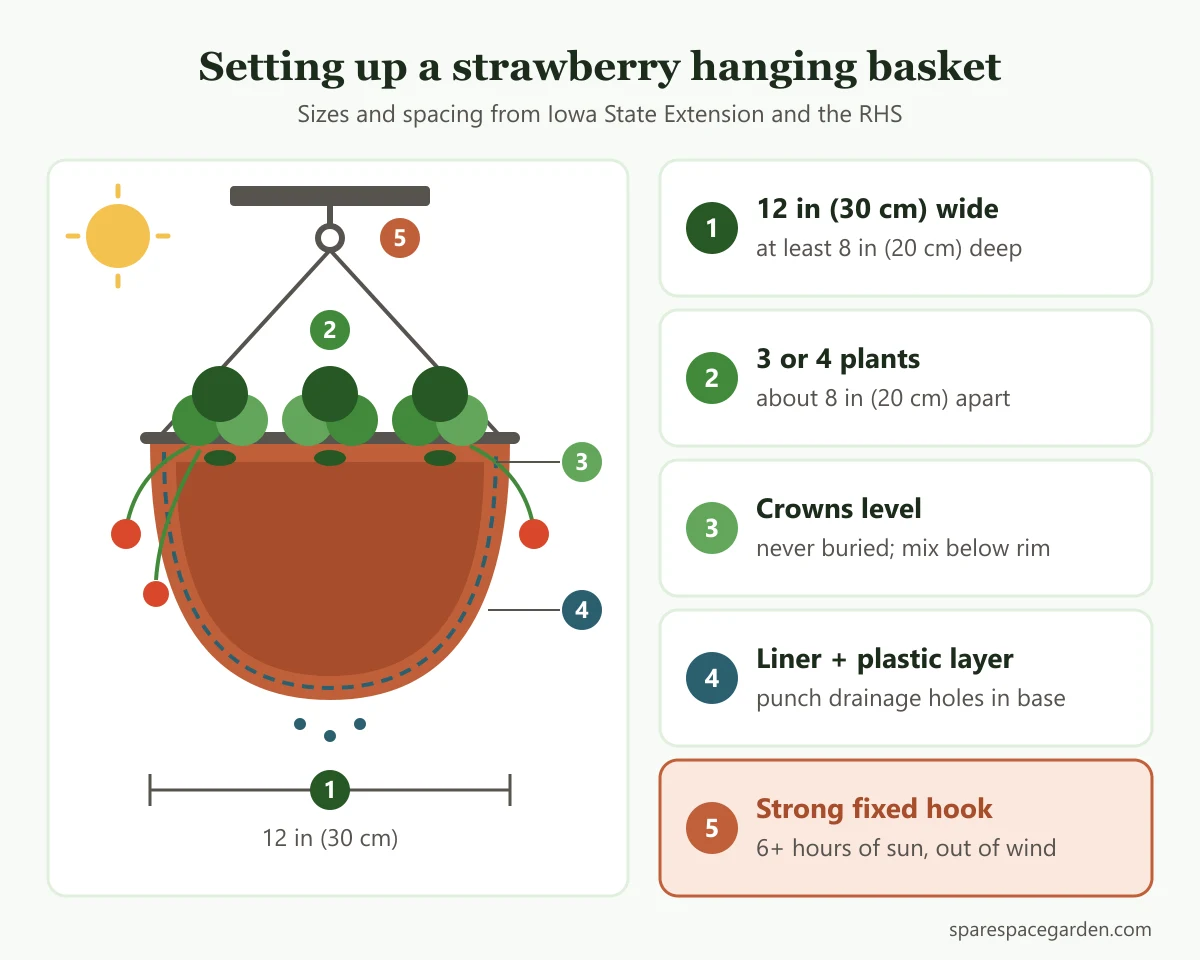 A basic setup for growing strawberries in hanging baskets.
Where to hang it: sun, wind and weight on a balcony
Strawberries want sun. Iowa State asks for at least 6 hours of direct sunlight a day, and the RHS recommends a sheltered, sunny spot. If your balcony gets less, our guide to apartment balcony plants explains how to count your hours of sun and what grows at each level.
Heat and wind
Full sun has a catch in a basket. Iowa State notes that hanging baskets get very warm, and that warm soil tends to shrink day-neutral fruit. On a hot, south- or west-facing balcony, a spot with morning sun and some afternoon shade can keep the mix cooler. Wind is the other drain: the RHS says baskets dry out faster on warm or windy days, so hang yours where a wall or the balcony ceiling breaks the gusts.
Height and weight
None of the sources give a fixed hanging height, but a basket you can reach easily is a basket you'll actually water. Illinois Extension talks about baskets hung at or slightly below eye level and baskets hung well above it; for strawberries, the lower option is more practical, since you can see the surface of the mix, spot ripe berries and pick them without a step stool.
Weight is easy to underestimate. In the RHS trial, a 5-liter (1.3-gallon) basket held 3.4 liters (about 0.9 gallon) of water at the start, and that water alone weighs about 3.4 kg (7.5 lb). Add mix, plants, liner and frame, and swinging in the wind on top. Hang baskets only from a hook fixed into the structure and rated for more than the wet weight, never over the outside of a railing, and check your building's rules first. If you're not sure what a ceiling or wall can hold, ask your building manager or a qualified professional before drilling. Our small balcony garden ideas cover safe overhead growing in more detail.
Watering every day in summer, and how to tell
Strawberries don't tolerate drying out. Iowa State says to check container plants regularly and water when the surface is dry, which may mean daily watering in summer and up to twice a day in heat. The RHS gives a simple test for baskets: gently lift or nudge it from below. If it feels really light, it needs water.
| What you notice | What it means | What to do |
|---|---|---|
| Basket feels heavy, surface damp | Enough water | Check again tomorrow |
| Surface dry, basket a bit lighter | Due for water | Water slowly until it starts to drip |
| Basket feels really light | Very dry | Water slowly in stages so the mix can absorb it |
| Leaves wilting, water runs straight out | Mix has dried out and shrunk | Stand it over a bucket, catch the runoff and pour it back in slowly |
| Mix soggy, water sitting on top | Overwatered or blocked drainage | Skip watering and check the drainage holes |
Water slowly. The RHS trial found that very dry compost sheds water instead of soaking it up, and that keeping the compost "just moist" wasted the least. The RHS also suggests watering strawberries in the morning and keeping water off the crown and fruit so any splashes dry quickly.
Watch out: Don't let a basket dry out completely. The RHS notes that very dry compost is hard to rewet, and Illinois warns that frequent severe wilting reduces basket quality.
Feeding, briefly
Frequent watering washes nutrients out of a small basket. The RHS feeds container strawberries every two weeks in the growing season, starting with a general-purpose liquid feed and switching to a high-potassium one when the first flower buds form. Iowa State takes a lighter approach, feeding two to three times a season with a water-soluble all-purpose fertilizer, ideally just after each flush of fruit is picked. Water the basket before feeding and dilute exactly as the label directs. For products and schedules, see fertilizer for hanging baskets.
Runners, birds, slugs and other problems
Runners
Day-neutral and everbearing plants make few runners, but those they do make often dangle over the edge. Iowa State says unrooted plantlets hanging from a container draw energy from the parent plant, so snip them off. You can let one or two small plantlets root right beside the parent and remove the rest as they form.
Birds and squirrels
Birds find ripe strawberries quickly, even on a balcony. The RHS advises covering plants with netting before the berries ripen, keeping it taut and secure so birds and other wildlife can't get tangled, and taking it off after harvest. It suggests chicken wire if squirrels are the problem. On a basket, a loose bag of fine netting gathered under the base is easy to fit and remove.
Slugs, vine weevil and disease
Height is one of the basket's advantages. The RHS says growing in containers helps reduce slug and snail damage, though it adds that vine weevil is a bigger threat to container plants, and biological controls can keep it in check. Disease spreads quickly in containers, so Iowa State advises removing diseased leaves or fruit as soon as you see them. Pick berries when they're red all over, cutting the stem about 1/4 inch (6 mm) above the cap, as Iowa State suggests.
Winter care, or starting fresh each spring
Sources split here, mostly by climate. Iowa State does not recommend overwintering container strawberries: at the end of the season, compost the plants and buy new ones in spring. A hanging basket gives roots even less protection than a pot on the ground, so where winters are hard, growing strawberries in hanging baskets as annuals is the simpler choice.
In milder areas, the RHS lists strawberries among the plants for long-lasting perennial baskets. In winter it recommends a sheltered, sunny spot, checking the basket even though it dries more slowly, and wrapping it in fleece in the coldest weather, which gives about 2°C (roughly 4°F) of frost protection.
Even plants that survive won't crop well forever. The RHS says a strawberry bed usually stays productive for up to four years and should be replanted every three or four years. In a small basket, replacing plants and mix sooner is reasonable if yields drop or leaves show disease.
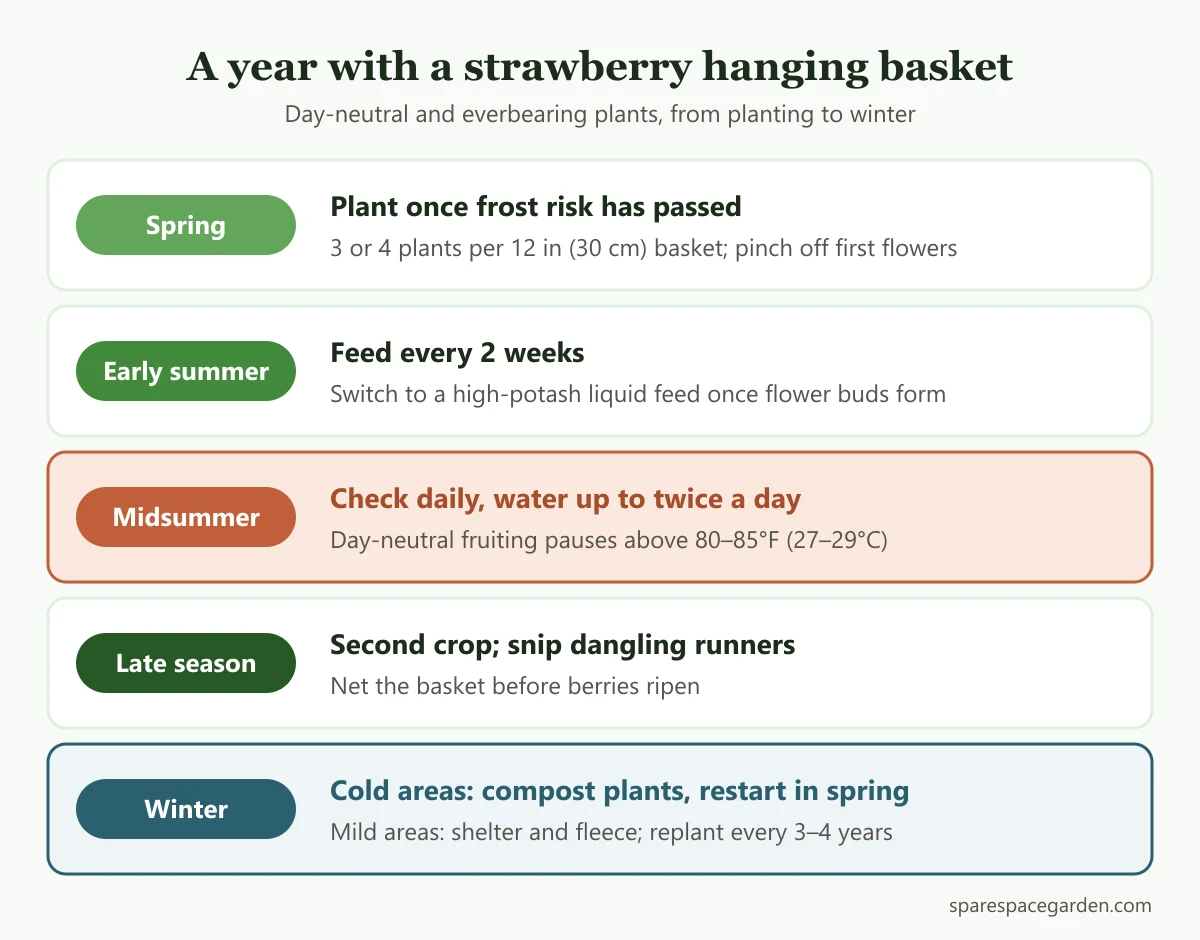 A year with a strawberry hanging basket, from planting to winter.
Frequently asked questions
How many strawberry plants go in a hanging basket?
Iowa State says a 12-inch (30 cm) container holds 3 or 4 plants, spaced about 8 inches (20 cm) apart. Go with three in a basket that's exposed to sun and wind, since fewer plants share the water. A larger basket can take more at the same spacing.
Do strawberries in hanging baskets come back every year?
They can in mild climates, and the RHS includes strawberries in perennial baskets. In cold climates, Iowa State recommends composting container plants in fall and starting with new ones in spring, because overwintering in containers rarely works well.
Why are my hanging basket strawberries so small?
Heat and dry mix are the usual causes. Iowa State notes that baskets get very warm and that warm soil shrinks day-neutral fruit, and those types stop fruiting above 80–85°F (27–29°C). Everbearing berries are also naturally smaller than summer-fruiting ones, according to the RHS.
How often should you water strawberries in a hanging basket?
Check every day in summer. Iowa State says containers may need daily watering and up to twice a day in hot weather; water when the surface is dry or the basket feels light when lifted. Water slowly so the mix absorbs it.
Should I cut the runners off hanging basket strawberries?
Yes, for most of them. Iowa State says unrooted runners hanging from a container drain energy from the parent plant. Keep one or two only if they root beside the parent, or peg them into small pots if you want new plants.